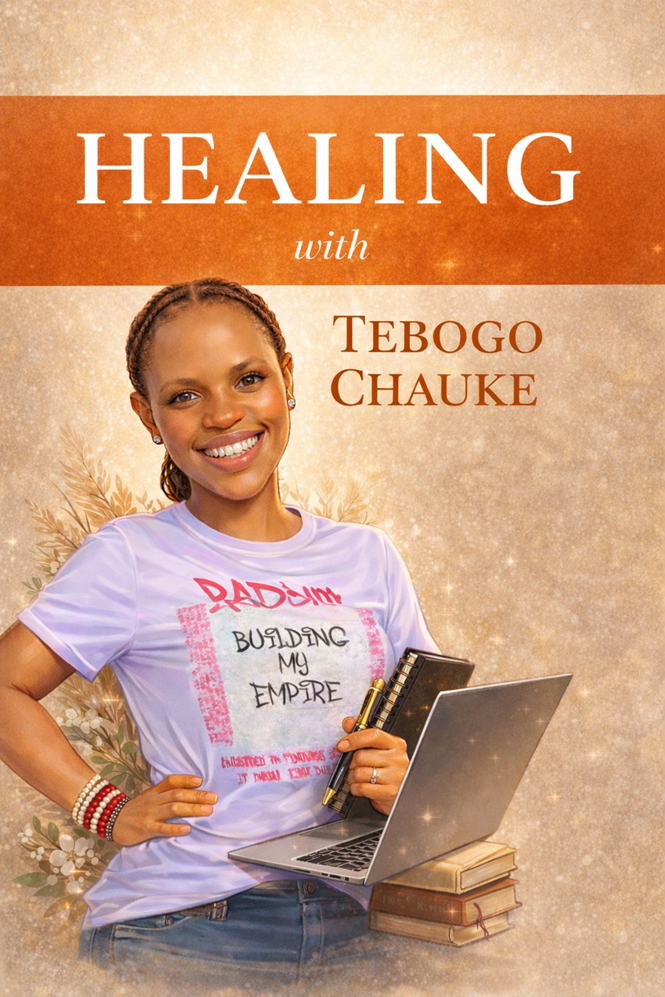
Healing with Tebogo Chauke
A Journey through Pain, Reflection, and Renewal
COPYRIGHT AND PUBLISHING
Copyright © 2026 Tebogo Chauke
All rights reserved. No part of this book may be reproduced, stored, or transmitted in any form or by any means, whether electronic, mechanical, photocopying, recording, or otherwise without prior written permission of the publisher, except for brief quotations in reviews.
First published in 2026.
For inquiries, permissions, or speaking engagements:
📧 [admin.chauke@tebogolibrary.co.za]
Author’s Note
This book is a journey of mine, and one I hope you can walk alongside. It is a space for reflection, honesty and healing. The experiences shared here are drawn from real-life challenges, lessons learned, and the ongoing process of understanding ourselves and the world around us. While each story, reflection, and insight comes from my personal journey, this book is not a prescription or a guide to living anyone else’s life. It is an invitation to pause, to feel, and to explore your own path to wholeness. Healing is rarely linear. It is often messy, slow, and deeply personal. My hope is that through these pages, you may find courage, clarity, and comfort. Also remember that no matter where you are in your journey, you are not alone.
Introduction
Life has a way of teaching us lessons we never asked for, in ways we aren’t always ready to face. Pain, loss, heartbreak, and moments of doubt can feel like walls closing in, but within those very moments, there is also the quiet space for healing.
This book is a collection of reflections, letters, and truths I’ve learned along my own journey of survival and self-discovery. Each page is an invitation to pause, reflect, and remember that no matter how deep the wound, the human spirit has a remarkable way of mending.
Healing with Tebogo Chauke is not about perfection. It’s about showing up for yourself even when the world feels heavy, about speaking your truth even when it scares you, and about finding the courage to keep walking forward, even if the steps are small. Whether you are carrying pain from your past, seeking clarity in the present, or trying to imagine a future that feels whole again, this book is for you. It is a companion for your heart, a mirror for your soul, and a gentle reminder that you are still here, and that alone is a triumph.
Let us begin, together.
Tebogo Chauke
I am Tebogo Chauke. I am a healer, a daughter, a sister, a mother, a friend, and a woman who has walked through darkness and emerged with a heart open to healing. I have stumbled. I have cried. I have questioned the purpose of pain, the meaning of loss, and the path forward when the world feels unbearably heavy. And through it all, I have learned that strength is not the absence of suffering, but, it is the courage to keep moving forward, even when every step feels like it takes all you have. As a healer, I have learned to see both the fragility and the resilience of the human heart. As a daughter, I carry the lessons of my family, the love that sustains me, the mistakes that have shaped me, and the hopes that continue to guide me. As a sister, I have discovered the power of connection, loyalty, and forgiveness. I have learned how holding someone in your heart can heal not just them, but you as well… and, at times, how it can also break you. As a mother, I have experienced love in its deepest, fiercest, and most patient form. A love that stretches beyond fear, doubt, or exhaustion. As a friend, I have witnessed the quiet beauty of presence in listening without judgment, holding space for another soul in their most raw and vulnerable moments, and learning that being present can be one of the greatest gifts we offer each other. And through every challenge, every heartbreak, and every quiet triumph, I have come to understand that healing is never solitary. It is a gift we give ourselves and a light we carry to share with others. I am here as someone who has felt loss, fear, and uncertainty. I am also here as someone who has discovered the quiet, unshakable strength that comes from understanding, forgiveness, and love. I am here to walk with you through the shadows, to comfort you when the weight of life feels too heavy, and to remind you that healing is possible, no matter how long or winding the journey. This book serves as an invitation to pause, to reflect, to embrace your own story, and to remember that even in the moments when you feel broken, you are still here, and being here is in itself, an act of courage.
COMING HOME TO SELF
As a Healer:
Understanding your calling and your humanity Many people think that being a Sangoma gives you some sort of superpowers, or that you can just wake up and create magic in your life, or in the lives of others. Often, people assume that because you are a healer, a Sangoma, praying day and night, you do not experience pain or that you do not face challenges like everyone else. In my journey, I discovered that people expected me to “get over it,” to make pain and hardships disappear. Some would even ask, “What are your ancestors saying about this? Why aren’t they helping you? Why aren’t they giving you money?” At one point, I thought the same things. I wondered why I was not spared from suffering, why the path I was given felt so heavy, and why I had to face struggles like anyone else. It took time for me to understand what being a healer truly means. What being born a Sangoma really entails. It was never what I had imagined. Some days, I would wake up and think, “Nope, this is not for me.” But then I would remember that if not for me, then for who? And why not for me? These questions were both humbling and powerful, and they kept me moving forward. I had to understand that being a healer is a journey, a quiet, slow, and often invisible process that unfolds in the spaces we least expect. I have learned that our pain, our struggles, and even our mistakes are the soil in which strength, resilience, and understanding take root. I have walked paths that were dark and heavy, both in my own life and alongside others. I have seen people crumble under heartbreak, despair, and betrayal. I have held space for tears that seemed endless and listened to words trembling under the weight of unspoken grief. And I have learned a vital truth that, sometimes the most powerful act we can offer ourselves or someone else, is simply presence. Being still. Being attentive. Being steady, even when the world feels unstable. I carry the healing and the solutions for many who don’t even know they’re bleeding. I enter spaces quietly, often unnoticed, but my spirit works loudly, mending what is frayed, lifting what is heavy, absorbing what others cannot hold. I sense the unspoken wounds, the pauses between words, and the pain people have learned to disguise as strength. And without being asked, I tend to them. Yet most times, I have no one to tend to my own personal pain. And believe me, it is understandable at times. Because, what I go through is often not of this world, and not everyone can comprehend it. Those who do understand are alsofacing their own challenges. And still, the healing does not stop, nor does it end. I hold peace in my hands, even when my own heart trembles. I offer calm when chaos spills into the room. I become steady when others are unravelling. I pour into dry places, knowing they may never pour back, knowing gratitude is not guaranteed, and restoration is rarely mutual. You call it strength. You call it a gift. You call me resilient, wise, an anchor. But you never ask what it costs me. You do not see the quiet toll of carrying everyone else to bed. You do not witness the nights I spend patching the holes in my own soul, stitching myself back together with thread made of prayer, silence, and endurance. You do not hear the exhaustion beneath my gentleness, or the ache that settles in my chest when there is no one left to hold me. And still, I heal. I still carry. I still listen to the pain behind their words and respond with care. I offer light even when I am walking through my own darkness, trusting that something sacred is at work even when I feel unseen. But I am learning that healers also need healing. That strength does not mean endless giving. That my tenderness is not an invitation to disappear. I am allowed to rest my hands. I am allowed to tend to my own wounds. I am allowed to be held, not just to hold.
As a healer, I do not exist to be emptied. I exist to live, to feel, to be whole. And honouring myself is not a betrayal of my gift, it is how I protect it. I have learned to listen to my own breathing, to pay closer attention to my body, to the tension in my shoulders, the ache in my chest, the heaviness that sometimes sits in my heart. I have grown to notice my mind, its fears, its doubts, the relentless questions that circle endlessly. And I have learned to tune into my spirit, to that quiet voice that knows the way even when my eyes cannot see it. Life has taught me that no pain is wasted. Every heartbreak, every loss, every struggle carries a lesson. If I am willing to sit with it, to feel it, and to learn from it, that is where healing begins. Healing starts when I give myself permission to truly listen, not just to the world, but to my own story, my own wounds, and my own choices. To give them space, allow them to speak, and let myself feel, without shame, without judgment because in listening, I find clarity. And in clarity, I find direction. Yes, I also learned that grief does not vanish; it transforms. It softens edges, deepens empathy, and teaches patience. I have seen people rise from circumstances they once thought would break them forever. And I have learned that resilience is not a miracle, but a practice, attention, and courage.
I have also learned that we cannot heal in isolation. Connection matters. Being witnessed, being supported, being held without judgment, these are acts of healing. They remind us that we are not alone, that our pain does not have to be carried in silence, and that even in our most fragile moments, we are seen, acknowledged, and valued. Healing is not about perfection. It is not about having all the answers or fixing every wound. It is about showing up for myself, even when life feels unbearably heavy. It is about choosing compassion over judgment, patience over frustration, and love over fear. It is about honouring my own story, embracing my scars, and remembering that my journey is mine alone. My heart deserves the same care, the same tenderness, the same patience that I give so freely to others. And so, I keep walking this path. I keep listening, feeling, tending, and learning. I keep trusting the process, even when it feels slow, invisible, or uncertain. Because healing is not just my gift, it is my life, my work, my truth. It is the light I carry through darkness, the hands I extend when others falter, and the quiet strength that keeps me moving forward. And in this truth, I hope to remind myself and anyone who reads these words, that no matter the pain, no matter the struggle, the heart is always capable of rising again. That even in our deepest moments of despair, there is a well of resilience within us, waiting to be tapped. That even when we feel broken, we are still whole in ways we may not yet understand. And that healing, in all its quiet, messy, beautiful complexity, is always possible.
Healing is not the absence of pain, it is the courage to hold your own heart, to listen, to rise, and to keep walking even when the world feels heavy. Because in showing up for yourself, you learn that resilience is not a gift, but a practice, and love is always worth carrying, even through the darkness.
Wholeness
For a long time, I believed healing meant fixing myself. I moved through life with the quiet assumption that something in me was damaged, that there was a fault line running through my being that needed repair before I could be worthy of love, peace, or rest. I carried my pain like evidence, like proof that I was lacking, behind, incomplete, and lost. Even in moments of strength, there was a voice inside me whispering that I was still not enough, that something essential in me had gone wrong somewhere along the way. I learned to look at myself through the lens of what hurt me. Through what and who failed me. Through the moments I did not survive in the way I wished I had. Pain became the measure of who I was. If it still hurt, then I must still be broken. If I was still struggling, then healing must not have arrived yet. I believed healing would come like an ending, in a clear moment when the ache would disappear, when the past would loosen its grip, when I would finally feel whole and untouched by what I had lived through. I thought healing would arrive the day I no longer felt pain. But wholeness taught me something different. It taught me that I am not broken. I was wounded. And there is a difference between the two. Broken implies something beyond repair. Wounded acknowledges injury without denying the possibility of care, growth, and restoration. I was shaped by experiences that demanded strength before I knew how to ask for help, before I had the language to name what was happening to me. I was required to survive things I did not understand. To adapt to absence. To make sense of silence. To carry unanswered questions that had nowhere to land. I learned to harden parts of myself that were once soft, not because I wanted to, but because softness did not always feel safe. I learned to quiet parts of myself that were once loud and expressive, because being heard did not always bring comfort. I learned how to keep going even when I did not know where I was going, even when the path ahead felt unclear and the weight behind me felt unbearable. I did not choose these lessons. But I learned them anyway. And that did not make me broken. It made me human. It made me someone who adapted, who endured, who found ways to survive in environments that did not always offer protection or understanding. It made me someone who learned strength before rest, resilience before softness, endurance before ease. And now, healing is teaching me how to return to myself, not as someone who needs fixing, but as
someone who deserves care. There is a difference between being broken and being hurt, but it took me years to understand it. Hurt convinces you that something inside you is wrong, that you are flawed at the core, that your pain is evidence of deficiency. Wholeness, however, reminds you that something inside you endured. It tells a quieter truth, that what survived matters more than what was lost. I remember the moment I lost my father. It is a strange thing to grieve someone you were never truly close to. Strange to feel a grief so heavy for a relationship that never fully existed. When I heard about his passing, something broke open inside me, something I did not know was alive and waiting. The pain arrived suddenly, violently, without warning or explanation. It moved through my body like a storm I had no name for, settling in places I did not know could ache. I was unprepared. I was confused. And in a way, I felt betrayed by my own reaction. I told myself the facts. I was never close to him. He never raised me. In many ways, he failed me. And yet, I was shattered. I could not understand why his death hurt so deeply when his presence in my life had been so small. My mind searched for logic, for justification, for permission to feel what my body was already carrying. I questioned myself constantly. I felt embarrassed by my grief. Ashamed of it. I told myself, you don’t get to hurt like this. He did not earn these tears. I tried to reason my way out of sorrow, as if pain required credentials before it was allowed to exist. I was angry, not only at him, but at myself. Angry that I was hurting. Angry that I could not control it. Angry that my body was grieving something my mind refused to defend. I did not know how to make the pain stop. I did not know how to speak about it, or if I was even allowed to. So I did what many of us learn to do when pain feels inconvenient, confusing, or unjustified, I swallowed it. I folded it inward. I carried on as though silence could erase what was already living inside me. And I let it destroy me quietly. For a long time, I did not realise that I was not grieving the man he was, but the father I never had. I was mourning the conversations that never happened, the guidance that never came, the protection that never arrived. I was grieving the love I hoped for but never received. His death did not just take him away from me, it closed a door I did not know I was still standing in front of, waiting for it to be opened. And that
kind of grief has no language. It exists in the space between hope and reality. It is the grief of possibility. The mourning of what could have been. The ache of knowing that whatever remained unresolved would now remain that way forever. There is no ritual for it. No script. No neat timeline. Only a quiet, persistent sorrow that asks to be seen. It took me years of screaming at my mother, of lashing out at the people closest to me, of carrying anger that had nowhere to land. Years of raised voices and slammed doors, of saying things I did not fully understand yet needed to release. It took years of silent tears cried in private moments, in the spaces between conversations, in the secrecy of late nights where I spoke only to myself. Conversations no one else could hear. Questions no one else could answer. Years passed before I could sit with what I was feeling instead of fighting it. Years before I could acknowledge the truth of my pain without trying to justify or explain it away. Years before I stopped demanding that my grief make sense, that it follow rules, that it be tidy and acceptable. It took years to forgive myself for feeling pain that did not fit neatly into logic or reason. To accept that hurt does not ask permission, and grief does not require evidence. That the body remembers what the mind tries to dismiss. That emotions do not become invalid simply because they are inconvenient or difficult to explain. And somewhere in those years, without noticing the exact moment, I began to soften. Not because the pain disappeared, but because I stopped punishing myself for carrying it. I learned that understanding does not always come first, sometimes compassion must lead the way. That, too, was part of the healing. Even now, I can say honestly that I am not fully healed from the father wound, not as a daughter. There are still moments when it surfaces unexpectedly, when old questions rise without answers, when the absence feels louder than it should. But I have learned to live with the pain. I have learned to name it without letting it define me. I have learned that acknowledging a wound is not the same as being consumed by it, and that, is wholeness. Wholeness is not the absence of pain. It is the courage to hold it without abandoning yourself. It is understanding that hurt does not mean broken, that grief does not mean weakness, and that survival does not require silence. Wholeness is allowing the story to exist exactly as it is, unfinished, imperfect, human, and still choosing to stand whole within it. Wholeness is not the absence of scars. It is the understanding that scars are not flaws. They
are records, etched reminders of what you lived through and lived beyond. They are evidence of survival, not failure. They do not announce weakness; they testify to resilience. Each scar tells the truth that something tried to take you apart, and it did not succeed. For a long time, I could only look at my life through the lens of what went wrong. I catalogued my losses carefully based on what I did not get, who did not stay, the dreams that dissolved before they could take shape. I mourned the versions of myself that never got the chance to exist, like the woman I thought I would be by now, the life I imagined I would be living, the ease I believed others seemed to carry so naturally. I measured myself against timelines I did not choose, expectations I inherited without consent, and standards that never made space for survival. And in doing so, I missed myself. But, by the grace of God, healing invited me gently, persistently to widen my lens. To stop asking only what did this take from me? And begin asking what did this require of me? It asked me to see the strength it took to keep going when stopping felt safer. To acknowledge the endurance it took to wake up on days when hope felt thin. To recognise the quiet wisdom earned through pain, the discernment, the boundaries, the softened compassion that did not come from ease, but from experience. It asked me to honour the parts of me that stayed when leaving would have been easier. The parts that adapted, adjusted, learned how to breathe in unfamiliar air. The parts that protected me in the only ways they knew how, even when those ways later needed gentler correction. These parts were never the problem. They were the proof. Wholeness does not ask you to erase your story. It does not demand that you rewrite the past or pretend it did not shape you. It asks you to hold your story with compassion, to stop punishing yourself for what you needed to survive, to stop judging your wounds as moral failures. I am learning that I do not need to become someone else to be whole. I do not need to reach a final version of myself before I am allowed rest. I do not need to heal everything at once, or understand everything immediately. I do not need to rush forgiveness, of others or of myself. I do not need to force peace before it is ready to arrive. I do not need perfection. What I need, what wholeness asks of me is presence. To be here with myself, exactly as I am. To listen instead of criticise. To care for what hurts instead of shaming it. To respond to my pain with curiosity rather than condemnation. This, I am learning, is a radical form of self-respect.
Some days, wholeness feels strong and grounded. It feels like clarity. Like breath returning. Like standing firmly in my own skin. Other days, it feels tender and unsure. It feels like moving slowly. Like asking for help. Like admitting I do not have the answers yet. And both are valid, both belong. Wholeness is not fragile because it includes softness. It is not threatened by uncertainty. It expands to hold every season of becoming, not just the triumphant ones. If you are here, reading this, wondering if you are too damaged, too late, or too much, please hear this clearly: you are not broken. You are becoming. And becoming is not a failure of wholeness; it is proof of it. Growth does not mean you were lacking before. It means you are alive, responsive, and still in relationship with yourself. Wholeness is not about arriving at some finished version of who you are meant to be. It is about staying. Staying with yourself when it would be easier to abandon yourself. Staying with the truth, even when it is uncomfortable. Staying with the parts of you that are still learning how to breathe again, how to trust, how to rest. And that, this staying, this choosing yourself again and again, is not just healing. It is home.
Wholeness is not the absence of wounds, but the courage to hold your story with compassion and recognise that surviving did not break you, but it revealed you.
Presence
For most of my life, I lived either in what hurt me or in what I feared might hurt me next. I replayed old conversations in my mind, rewrote endings that had already been sealed, and carried memories like unfinished business. When I wasn’t looking backward, I was rushing forward, anxious about what might go wrong, what I might lose, what I might fail to become. Very rarely was I simply here. Presence did not come naturally to me. Survival had trained me well. It taught me to scan for danger, to anticipate disappointment, to prepare for the next emotional storm before the clouds even gathered. My body would be in one room while my mind wandered somewhere else entirely. I smiled while silently spiralling. I nodded while replaying yesterday’s wounds. I lay awake at night rehearsing tomorrow’s fears. I did not know that absence from the present was also a form of self-abandonment. Looking back, it makes sense. When you have known pain and deep disappointment, vigilance feels safer than rest. Life had taught me to be alert, to read the shifts in people’s tones, to notice what was not said, to brace myself for impact. And many people will understand this, especially those who have lived through betrayal, instability, or trauma. You do not simply “relax” after that. Your nervous system remembers. Your body remembers and it stays ready. I realized that as a child, as a woman, as a human being, it is hard to be where you are when where you are feels unsafe. Sometimes the present moment is not peaceful. Sometimes it is you being ripped apart by someone you trusted. Sometimes it is watching love change shape. Sometimes it is standing in the middle of something breaking and knowing you cannot stop it. In those moments, leaving, mentally or emotionally feels like protection. But what I did not understand then was that constantly leaving meant leaving myself, and even in small ways, slowly I disconnected me from my own life. I was surviving it, but I was not inhabiting it. Let’s firstly understand that, presence is not pretending that everything is okay. It is not denying pain, and it’s not a spiritual bypassing. It is choosing gently and intentionally to stay with what is real even when it is uncomfortable. It is allowing yourself to sit in a moment without immediately trying to escape it, fix it, or outrun it. I’ve learned that to be present means retraining my body to feel safe in stillness. It means noticing my breath when anxiety tries to pull me into the future. It means catching myself when I start reliving something that has already ended. It means asking, “What is true
right now?” instead of “What if?” because presence has taught me that not every moment is a threat. That not every silence means abandonment. That not every pause means something is about to fall apart. It has taught me that peace is often quiet, so quiet that if you are always scanning for disaster, you will miss it. And slowly, I am learning to stay. To stay in conversations instead of drifting into defence. To stay in joy without waiting for it to disappear. To stay in grief without numbing it. To stay in love without rehearsing its ending. Presence is becoming an act of trust. Trust in myself, trust in this moment, trust that I can handle what is here without abandoning who I am. Yes, I am still learning. Some days I slip back into old patterns. Other days my mind runs ahead into imagined disasters or drags me backward into memories I thought I had already made peace with, especially when something triggers me, like a tone of voice, certain silence, or a familiar feeling of being misunderstood. My body reacts before my logic does. I’m still alert. But now, the difference is that I can manage it, I can handle it, I can feel the wave without letting it drown me. I can recognise the trigger without building a home inside it. I can say to myself, “This is old. This is not now. This does not have a place in me.” Before, my reactions controlled me, but now, I observe them. And noticing is the beginning of returning. Returning to my breath, my body, and to the woman standing in this exact moment, not the wounded child, not the anxious future version, not the disappointed past version, but the woman here. And that, too, is healing. Learning to be present was never dramatic. It did not arrive with fireworks or revelations. It did not come in a single breakthrough moment where everything made sense. It began quietly. One day I noticed how shallow my breathing had become. I noticed the constant tightness in my shoulders, the way my jaw clenched without permission, the way my heart raced even in still rooms. I noticed how easily I startled. How quickly I tensed. How hard it was to relax even when there was nothing to fight. My body was living as though something was always about to happen, but nothing was happening. And that realization changed me. Because I understood then that I was not reacting to my present life, I was reacting to my past. My nervous system had not caught up with my reality. It was still bracing for impact long after the storm had passed. Presence started with small questions. Gentle interruptions. Sometimes the answer was simple as, I am sitting. I am breathing. I am okay. The room is
quiet. No one is attacking me. Nothing is falling apart. Other times, the answer was harder, I am sad. I am triggered. I am remembering something I have not processed. I am afraid of repeating a pattern. I am afraid of being hurt the same way again. But naming the present softened it. There is something powerful about telling the truth to yourself in real time. When I say, I am anxious right now, the anxiety loses some of its authority. When I say, I am afraid, fear stops pretending to be anger. When I say, this reminds me of something old, I separate the past from the present. I learned that the present moment is not my enemy. It is the only place healing can occur. The past cannot be changed. The future cannot be controlled. But right now, in this breath, this heartbeat, this awareness, this is where power lives. Presence taught me that pain grows louder when ignored. When I distracted myself, it chased me. When I numbed it, it returned stronger. But when I paused long enough to feel it fully, without distraction, without judgment, it stopped demanding my attention so aggressively. It did not disappear, but settled. It softened and asked to be acknowledged, not escaped. And slowly, I began to understand something profound, that I am not afraid of the present moment. I am afraid of what I think it means. I am afraid of what it reminds me of. I am afraid of what it could become. But when I stay, and I mean truly stay, most moments are manageable. Most emotions move, and most fears shrink when faced gently. Presence has become my anchor. Every time I notice instead of react, every time I breathe instead of spiral, every time I stay instead of abandon myself, I build safety within. And that safety becomes quiet, steady and earned. That is healing in real time. I had to sit with emotions I once ran from, loneliness, anger, grief, regret. They were not pleasant feelings. They were heavy, uncomfortable, and sometimes overwhelming. But they were necessary. What I once saw as unbearable began to reveal itself as beneficial. Feeling them did not destroy me. Avoiding them had. I had to sit with joy too. And that surprised me. Because I realized I had also been absent from my own happiness. I rushed through beautiful moments as if they were temporary interruptions instead of sacred gifts. I minimized my wins. I postponed celebration, and I waited for “more” instead of honouring “now.” Presence changed all that. I began noticing sunlight spilling through my window. The sound of my own laughter, which was full and unrestrained. The way my children’s voices filled a room with life. The warmth of a cup of tea resting in my hands. The steadiness of my breath when I
allowed it to slow. I began to understand that healing is not only about tending wounds. It is also about fully inhabiting your life. Being present does not mean pretending the past did not shape you. It means refusing to let it dominate you. It does not mean ignoring the future. It means trusting that when it arrives, you will meet it then, not now. Presence is choosing to return to yourself again and again. The more I practiced presence, the less power my triggers held over me. I noticed patterns sooner. I caught myself before spiralling. I responded with curiosity instead of shame. Instead of asking, “Why am I like this?” I began asking, “What is this moment trying to show me?” That question changed everything. Presence gave me space between emotion and action. And in that space, I found choice. Choice to pause, soften, speak differently, and to break a pattern instead of repeat it. Some days I still drift. I still worry. I still revisit old stories. But now I know how to come back. Because wholeness is not only about knowing you are not broken. It is about being fully here, with who you are now. It is practice, not perfection. It is the quiet decision to stop running from your own life. And every time you choose to return to this moment, you choose healing again.
Each time you return to the present moment instead of running from it, you choose healing over fear.
Listening to my own voice
For many years, I listened to everyone else before I listened to myself. I became fluent in other people’s needs. I could sense a shift in tone before conflict surfaced. I could feel disappointment before it was spoken. I could anticipate what was required of me before anyone asked. But I did not always listen to my own body when it whispered, to my mind when it spiralled, and to my spirit when it grew tired. As a healer, I am gifted to sense and notice other people’s emotions, their wounds, their unspoken pain. I walk into a room and feel what is broken before anyone says a word. I hold space for tears that are not mine. I pray for storms I did not create. I sit with people in their darkness without flinching. But when it comes to my own storm, I have often stood outside of it, pretending it isn’t raining. I ignore the ache in my chest and call it strength. I dismiss my exhaustion and call it discipline. I silence my frustration and call it maturity. I knew how to show up for everyone else except for myself. But now, I am still learning how to show up for myself. Somewhere along the way, I confused self-sacrifice with love. I believed that tending to myself meant neglecting others. That slowing down meant falling behind. That saying, “I need a moment,” was selfish. But ignoring myself did not make me stronger. It instead made me fragmented. My body began to speak louder when I refused to listen gently. Tension became constant. Fatigue became normal. Irritability became frequent. My mind grew noisier with overthinking, second-guessing, replaying conversations long after they ended. And my spirit? My spirit grew quiet. Listening to myself means relearning a language I once knew instinctively, the language of body, mind, and spirit. My body speaks in sensation. The heaviness in my chest, the tightness in my shoulders, and the exhaustion that sleep cannot fix. Those are not inconveniences. They are messages. My body remembers what my mouth refuses to say. It tightens when I am over giving. It aches when I am betraying myself. It grows tired when I am performing resilience instead of living in truth. Sometimes healing begins with rest and honesty, the kind of honesty that admits I am tired, that I am afraid, that I am not as certain as I pretend to be. For a long time, I believed every thought that passed through my mind. I treated fear like prophecy and doubt like truth. If a thought said I was not
enough, I accepted it as evidence. If it whispered that something would fail, I braced myself as if it already had. I did not question the voice, I assumed it was wisdom. But listening to my mind does not mean obeying it. It means observing it. It means creating space between the thought and my reaction. It means noticing when anxiety is speaking. Noticing when shame is loud. Noticing when my inner critic sounds less like my own voice and more like echoes from my past. Listening means asking, gently if this truth? Or if this fear is trying to protect me or distract me? I am learning that not every thought deserves authority. Some thoughts are simply memories dressed as warnings. Some are habits formed in survival. Some are younger versions of me trying to stay safe. When I slow down enough to notice, my mind softens. It becomes less of a battlefield and more of a messenger. And healing begins in that space, the space between the thought and the belief, between the fear and the decision, between the voice and my response. And then there is my spirit. My spirit does not shout, it whispers. It nudges when something feels aligned. It grows heavy when something feels wrong. It becomes distant when I ignore it for too long. There were seasons when I silenced my spirit to survive, by choosing what was practical over what was peaceful, what was expected over what was aligned. But my spirit never left me. It waited. As a Sangoma, I understand that spirit is sacred. But I am learning that my own spirit is sacred too. When my body, mind, and spirit are disconnected, I feel scattered. When they move together, I feel whole. Listening to myself is not selfish. When my body says rest, I pause. When my mind says I am overwhelmed, I breathe. When my spirit says something is not right, I pay attention. Because healing others means nothing if I am abandoning myself. The most sacred relationship I will ever have is the one I build within. My body speaks in sensation. My mind speaks in thought. My spirit speaks in knowing. Healing begins when I honour all three. And when I learned to sit with my own silence, I discovered that everything I was searching for was already speaking inside me.
I can guide others toward wholeness, but my deepest healing begins when I become attentive to the wisdom within.
Self-Awareness
Self-awareness is one of the hardest forms of healing. It is easy to see what others did to you. It is easy to point to the betrayal, the abandonment, the silence, the disappointment. But it is much harder to sit with yourself and ask, “What did I do to myself in the process of surviving?” so, for a long time, I thought self-awareness meant criticism. I thought it meant dissecting my flaws, highlighting my mistakes, and holding myself accountable in a harsh, almost punishing way. I confused honesty with self-judgment. I believed that if I was not hard on myself, I would never grow. But healing taught me something different. Self-awareness is not about attacking yourself. It is about seeing yourself clearly without denial, without exaggeration, without cruelty. It is the courage to admit that I stayed too long, I ignored the red flags, I abandoned my own needs, I reacted from pain instead of wisdom, and I loved in ways that were rooted in fear. And at the same time, it is also the courage to admit that I did the best I could with what I knew then, I was trying to survive, I was protecting parts of myself that felt unsafe, I was longing to be loved. Self-awareness holds both truths. As a healer, I had to look at myself beyond the role people see. Beyond being “strong.” Beyond being “wise.” Beyond being the one others run to. I had to ask myself uncomfortable questions. The questions that are not easy to ask, and I have to admit that some of the answers I got, humbled me. Some answers did hurt a lot and some, forced me to confront patterns that did not serve me. But awareness did not shame me. It freed me instead. Because you cannot heal what you refuse to see. And you cannot grow from a version of yourself you are pretending to be. Self-awareness has taught me to sit with my triggers instead of projecting them. To recognise when I am reacting from an old wound instead of a present reality. To pause before speaking when emotion is loud. To apologise when I am wrong. And to forgive myself when I am still learning. Seeing myself honestly does not mean I am broken, it means I am brave. Seeing myself gently does not mean I avoid responsibility. It means I understand that growth requires safety, even from myself. I am learning that self-awareness is a lifelong practice. Some layers reveal themselves quickly, while others take years to surface. Sometimes I discover strength I did not know I carried. Other
times I uncover fears I thought I had already healed. And both are part of my becoming, my healing, and my growth. So, if you are walking this path too, let this be your reminder that, you can look at yourself truthfully without tearing yourself apart. You can own your mistakes without losing your worth. You can evolve without hating who you used to be. Self-awareness is not about perfection. It is about alignment. It is the quiet decision to know yourself deeply, and still choose yourself.
Self-awareness is the quiet discipline of observing my thoughts, honouring my feelings, and choosing alignment anyway.
OPENING THE HEART
Embracing Vulnerability
For a long time, vulnerability felt dangerous to me. I learned early that showing too much of myself could be used against me. That tears could be misunderstood as weakness. That honesty could invite judgment. So I became strong, composed and self-contained. I learned how to hold my pain privately and present resilience publicly. People saw strength. They did not see the effort it took to maintain it. They did not see the constant monitoring of my emotions, the careful editing of my words, the way I swallowed disappointment before it reached my face. They did not see the quiet, exhausting work of keeping myself contained so others would never worry, especially my children. I had to hide my true feelings so that they would not sense my fear. I had to hide my tears so they would not see me in what I felt was weakness. I remember a day when there was no food in the house, no electricity, and the rent was due in just a few weeks. I was alone with my children, unsure where help would come from or if it would come at all. I felt like a failure. In my heart, in my mind, I saw myself as a burden to others. And as a Sangoma, a healer, I believed I could not ask for help, not from anyone, not even from the people I trusted. I sat down and cried. The grief, the fear, the exhaustion, it all came all at once. And then I heard the voices of my children calling from the next room. Immediately, I wiped my tears and forced myself into a posture of prayer. I mouthed words I barely felt, because I did not know what else to do. While all I wanted to do was release my fear, my despair, and my helplessness. I simply wanted to cry and let it out. But I couldn’t. Not yet, not with them around, knowing that they could be listening. In that moment, I felt the weight of every expectation I had to carry as a healer who must always be strong, the mother who must never show weakness, and the woman who must hold it all together even when she is breaking. Even now, I feel low when I remember that version of myself. I feel the hurt of the woman who had no words left for God or for my ancestors, who felt silenced by her own life. I felt powerless, unseen even by myself. Yet in that very moment of hiding, I also learned the courage it takes to show up even when you are broken. The resilience it takes to protect others while your own heart aches. And the quiet truth that vulnerability does not make you weak, it makes you human. Because even though I pretended to pray, even though I held my tears, even in that desperate silence, I was still surviving. I was still moving forward. I was still a mother, a
healer, a woman trying to carry her life with what little strength remained. And that, I realize now, is also a form of grace. Vulnerability did not feel like freedom. It felt like exposure, and exposure felt unsafe. When you have been disappointed, betrayed, or left to carry things alone, you learn to protect yourself. You measure your words. You reveal yourself in pieces. You test people before trusting them. You convince yourself that independence is safer than intimacy. You become practiced at holding space for everyone else, while keeping your own space locked. And for a while, it works. You function. You succeed. You appear steady. You become the dependable one, the strong one, the one who rarely needs anything. People lean on you. They admire you. They praise you for being unshakable. Until you realise that protecting your heart can slowly turn into isolating it. I did not know that in trying to avoid being hurt, I was also avoiding being fully known. I did not realise that strength without openness can become loneliness in disguise. That the very armour I built to keep myself safe was also keeping connection, intimacy, and even joy at a distance. Letting yourself be seen is subtle. It is choosing to say, “That hurt me,” instead of pretending it did not. It is admitting that, “I am struggling,” instead of automatically saying, “I’m fine.” It is allowing someone to witness your uncertainty, your questions, your fears, without rushing to clean it up so you appear composed. It is resisting the urge to perform healing when you are still healing. It is choosing honesty over perfection, presence over performance, intimacy over safety. It is leaning into discomfort long enough to let someone touch the edges of your real self, not the curated version, not the version you think will be accepted, but the raw, imperfect, still-learning version. It is the recognition that being seen does not always mean being approved of, and yet it is still worth the risk. That courage is not measured by how little you show, but by how much you allow to be seen. It is the slow, quiet surrender to being fully human, with all your cracks, all your questions, all your tenderness. As a healer, vulnerability has been one of my greatest lessons in my life journey. People often assume that because I hold space for others, I do not need space myself. That because I offer wisdom, I do not wrestle with confusion. That because I guide, I do not get lost. But I do. There have been seasons where I carried everyone and told no one how heavy it felt. Seasons where I prayed for strength but did not admit I was tired. Seasons where I wanted to be held but did not know how to ask. Seasons where I wore composure like armour, while my
heart ached beneath it. I confused being needed with being valued. I confused being strong with being silent. I confused resilience with absence of need. Vulnerability required me to soften. To tell the truth about my limits. To admit when I was overwhelmed. To say, “I cannot carry this alone.” To stop performing strength and start living honestly. To stop hiding behind the polished version of myself and start showing the edges, the rawness, the cracks. And it was uncomfortable. Because when you let yourself be seen, you risk being misunderstood. You risk being rejected. You risk someone not meeting you where you are. You risk discovering that not everyone has the capacity to hold your truth. You even risk revealing the parts of yourself you have protected for so long that you aren’t sure if anyone else will honour them. But you also give yourself the chance to be loved fully, not just admired for your strength, but embraced in your humanity. I am learning that vulnerability is not weakness. It is courage without armour. It is truth without performance. It is strength that does not need to prove itself. It is saying, “This is me, not just the healed parts, but the healing ones too.” It is trusting that the right people will not run from your honesty. They will honour it. They will handle it gently. They will not weaponize your openness. They will meet you with patience, presence, and care. Vulnerability is also a quiet teacher. It shows you where you have been hiding. It reveals the patterns that keep your heart closed. It exposes the places where fear has ruled, and yet it does so without blame. It asks you to look at yourself with honesty and compassion at the same time. And even when someone does not respond the way you hoped, vulnerability still serves you. Because it is not dependent on their reaction. Because it is an offering to your own truth first. Because you chose authenticity over fear. You chose truth over protection. You chose alignment over image. You chose intimacy over isolation. And you chose presence over performance. Letting myself be seen has deepened my relationships. It has strengthened my boundaries. It has helped me recognise who is safe and who is not. It has reminded me that I do not have to earn love by being invulnerable. It has taught me that intimacy begins with self-trust. That openness with others starts with openness with myself. That courage is not measured by how little I feel, but by how fully I allow myself to be known. I am learning that vulnerability is not a risk to be feared. It is a doorway. A doorway to connection, to healing, to freedom. It is a way of saying, “I am here. I am human. I am enough as I am.” And
in that space, where I stop protecting and start allowing, I find the quiet joy of being seen and accepted, not for what I can do or how strong I am, but simply for who I am. If you are afraid to be seen, I understand. Truly. But hiding does not heal you, being witnessed does. Being seen in all your hesitation, your questions, your messy humanity, is medicine for the soul. And sometimes, the first person who needs to see you clearly without judgment, without shame, without rushing to fix yourself, is you. Look at your own heart. Look closely, because healing begins the moment you stop hiding from your own humanity. And vulnerability is not a gift you give to others. It is the permission you give yourself, permission to exist fully, tender, open, and real. Permission to feel without judgment, to speak without apology, to live without the constant weight of performance. In that openness, you discover a freedom you never knew existed. The freedom to be imperfect, to stumble, to not have all the answers. The freedom to ask for help without shame, to lean on others when your own strength runs thin. The freedom to let your heart lead without fear, even when it trembles, even when it risks being hurt. Vulnerability is a practice of courage. It is not a single act, but a way of being, of showing up, again and again, with all of yourself intact, even when you feel fractured. Because wholeness is not about never being broken. It is not a perfect collection of pieces stitched together to look flawless. Wholeness is about showing up anyway. Showing up with your scars, your doubts, your questions, your longing. Showing up with your hands open when you want to close them. Showing up with your voice trembling when you are used to speaking confidently. Showing up fully, without apology. And in that daily practice of courage, you find something sacred: a quiet strength that does not demand validation. A sense of peace that is rooted not in control, but in acceptance. A deep knowing that even in your fragility, you are whole. So look at your own heart. Listen. Honour what you feel. Let it teach you. Let it guide you. And let yourself be seen, first by yourself, and then, by the world. Because the more you allow yourself to exist fully, the more you open the way for true connection, deep healing, and the kind of freedom that can only come when you are brave enough to be human.
Vulnerability is not the absence of strength, it is the courage to let your humanity be visible.
Feeling without Apology
For a long time, I apologised for how I felt. I apologised for being “too sensitive.” For crying too easily. For being hurt longer than people thought I should be. For needing time. For needing space. For needing understanding. Somewhere along the way, I learned that emotions were inconveniences. That they made other people uncomfortable. That strength meant composure. That maturity meant silence. So I swallowed things. I swallowed anger until it turned into tension in my shoulders, a constant tightness I carried like armour. Like the anger I felt for grieving my father even decades after his passing, for the absence that never seemed to ease. Like the anger I felt for losing the only man who had been a true definition of a father figure, the man who raised me, who guided me, who loved me as his own. I felt anger toward my mother, too, for not understanding me, without me pausing to understand where the misunderstanding came from, without seeing the ways we were both trying, yet failing to meet each other. I felt anger for losing my virginity without my permission, for the violation of my trust and the betrayal of my innocence. I swallowed sadness until it settled heavy in my chest, pressing on my ribs like an uninvited guest who refused to leave, a weight that made every breath feel like effort. I swallowed disappointment until it became distance, a quiet withdrawal from myself and from others, a protective barrier that left me feeling isolated even in a crowded room. I swallowed fear until it whispered behind my back, shaping my choices, nudging my steps, dictating my boundaries, all without me even realising. I swallowed joy too, out of suspicion, afraid it would be fleeting, afraid it would highlight the contrast of my pain, afraid it would make me vulnerable again. I didn’t believe I deserved joy, or happiness, or even peace in my life, so I swallowed it all down, along with the laughter that tried to rise in my chest. And then I wondered why my body felt tired all the time. Why my mind was always busy, replaying moments I could not change, second-guessing every word I had spoken or withheld. Why I carried shame for things that were never mine to bear. Why my heart felt heavy, as though it were carrying not only my own burdens but everyone else’s as well, compressing the space where love and light could grow. Why my spirit felt dulled, quiet, almost invisible, as if it had been forced to shrink, fold in on itself, to fit into a life that demanded composure above all else. And in that quiet exhaustion, I began to understand that my body, my heart, my
mind, and my spirit had been keeping score. Every swallowed emotion, every hidden tear, every denied joy had left a mark. They were all speaking to me, begging for acknowledgment, for space, for release. It was then that I realized my tiredness was not weakness. It was proof, proof that I had survived the weight of unspoken pain, proof that I had carried more than anyone could see, proof that I was human, fully and deeply human. It took me a long time to realise that exhaustion was not just physical, it was emotional, spiritual. It was the body and soul whispering, “You cannot hold this in forever. You cannot carry everything without pause. You are human. You need to feel.” And in that quiet whisper, I began to understand the cost of apologising for my emotions, that every time I silenced myself, I lost a little more of who I truly was. Healing taught me something different. It taught me that emotions are not weaknesses to manage, they are messages to honour. Anger is not wrong. Sadness is not dramatic. Fear is not failure. And Joy, is not foolish. When I stopped apologising for my feelings, I stopped betraying myself. Feeling without apology does not mean reacting without responsibility. It means allowing the emotion to exist without shaming it. It means saying, “I am hurt,” without adding, “but it’s probably my fault.” It means saying, “That made me angry,” without convincing myself I am overreacting. There were times in my life when I felt things deeply but acted as if I did not, especially with the people I loved. I minimised my pain so they would not feel guilty. I silenced my disappointment so I would not seem difficult. I stayed calm on the outside while chaos moved through me internally. And that kind of self-abandonment leaves scars, not only on the heart, but on the body and spirit. Tension settles in muscles that have held anger too long, wrapping the shoulders and neck in a weight that never lifts. Breath becomes shallow when grief is buried, each inhale hesitant, each exhale restrained. Sadness lingers in the chest, pressing down like stones no one else can see. Fear whispers constantly, steering choices and constricting freedom without notice. Joy struggles to emerge when fear has been a constant companion, and happiness feels dangerous, as if welcoming it could somehow betray past pain. Every suppressed emotion leaves its mark, a physical ache, a restless mind, a spirit that dims over time. It is the quiet erosion of self, the slow dimming of light that once shone freely within. And yet, in all of this, there is a lesson that the body remembers, the heart
remembers, the mind remembers. Every tension, every shallow breath, every hidden tear is a signal calling for attention, calling for acknowledgement, calling for permission to be felt fully. I am learning that healing is not about erasing the pain or pretending it does not exist. It is about listening, honouring, and responding to what my emotions are trying to tell me. It is about creating space within myself where anger can inform, sadness can release, fear can protect, and joy can flourish without suspicion. Because when I allow myself to truly feel, I do not just survive, I reclaim pieces of myself I had abandoned along the way. I restore vitality to my body, clarity to my mind, and presence to my spirit. And in that reclamation, I discover something remarkable: that feeling fully is not weakness. It is power. It is wisdom. It is the path back to myself. As a healer, I have seen how many of us are disconnected from our own emotional truth. We analyse our feelings instead of feeling them. We justify them, compare them, and we rank them. We ask whether we are “allowed” to feel a certain way, as if emotions require permission to exist. But emotions are not court cases. They do not need evidence. They do not need approval. They only need space. Giving my emotions permission has meant sitting with them instead of rushing to fix them. It has meant crying without explanation, letting the tears fall without worrying about what anyone else might think. It has meant allowing grief to move through me without trying to control its timeline or measure its intensity. It has meant admitting when something affected me more than I expected, even when I had been taught to “move on” quickly. It has meant naming my fear without shrinking from it, acknowledging its presence without letting it paralyze me. It has meant acknowledging anger without letting it define me, without letting it spill uncontrolled, but without hiding it either. It has also meant allowing joy without suspicion, a lesson that took years to learn. That was a big one for me. Sometimes, when you have lived through a lot of pain, happiness feels unsafe. You wait for something to go wrong. You brace for impact. You hold back from fully enjoying what is good, as if claiming pleasure might somehow betray all the suffering you have survived. But healing invites you to feel fully, not just the pain, but the beauty too. It asks you to inhabit your body, your heart, and your mind completely. To notice the weight of grief, the surge of joy, the pull of fear, the heat of anger, without judging any of it. To honour each sensation, each thought, each
rising emotion as a teacher, a messenger, a guide. To recognise that every feeling has a reason for being, every emotion carries wisdom, and even the most uncomfortable ones are pointing toward something that needs to be seen. Allowing myself to feel fully has taught me that emotions are not obstacles to overcome; they are signposts on the path to wholeness. They remind me that I am alive. That I am human. That I am capable of receiving the fullness of life, its grief, its loss, its beauty, its joy. And in giving myself that space, I have discovered the quiet power of self-permission, the ability to honour my inner life without apology, to respect my own experience, and to meet myself with gentleness and curiosity instead of shame or judgment. I am learning that healing is not just about surviving pain. It is about feeling life in its entirety. It is about cultivating the courage to sit with every emotion, even the ones that scare us. It is about listening to what our heart, mind, and body are trying to teach us, and trusting that the lessons they bring will guide us home to ourselves. Feeling without apology is freedom. It is choosing authenticity over performance. It is trusting your inner experience. It is honouring your humanity. I am no longer interested in shrinking my emotions to make others comfortable. I am interested in understanding them. In tending to them. In learning from them. In listening to what they are trying to teach me about my body, my mind, my heart, my spirit. In giving them the space they deserve, I give myself the space I deserve. Because when I give my emotions permission, I give myself permission to exist fully. And that is not weakness. That is power. It is a quiet, steady, unshakable power, the kind that cannot be taken from you, because it comes from within. It is the power to be whole while still feeling. It is the power to be human. It is the power to meet yourself in your full spectrum, the joy and the sorrow, the fear and the courage, the light and the shadow and to say, “I am enough, even here.” It is the power to finally stand in your own life, not as a caretaker of others’ comfort, but as a guardian of your own truth. It is the power to honour your boundaries, to speak your truth even when it feels risky, to release what no longer serves you, and to receive what your heart truly needs. It is the power to allow yourself tenderness when you are fragile, and to honour your strength when you are resilient. It is the power to show up fully, messy, imperfect, real, without shrinking, without apology, without compromise. It is the power to choose
presence over perfection, self-compassion over self-criticism, and alignment over pleasing. It is the power to hold your own hand through the storms of your life, to witness your own pain, to celebrate your own joy, and to affirm, “I am worthy of all that I feel.” This is the freedom that comes when you stop negotiating with your inner life. This is the power that rises when you stop apologising for being human. This is the courage that lives in standing fully in your own life, seeing yourself completely, and saying, “Here I am, with all of me, and I am enough.”
Feel without apology, love without conditions, and exist without restraint, because in your emotions lies your greatest strength.
Trusting Your Inner Voice
For years, I sought answers everywhere but within. I looked for advice from friends, the opinions of family, the guidance of books and teachers, and even the judgment of strangers. I thought wisdom came from outside me, and that certainty meant proof. But I have learned slowly, insistently, that the deepest guidance comes from within. That quiet, steady voice that whispers even when the world is loud. That nudge in your chest when something feels off. That still knowing that arises in moments of pause, when logic and fear collide. Intuition is not always loud. It does not always shout or insist. It rarely arrives in neat, explainable words. It comes as a feeling, a pull, a hesitation, a light in the corner of your mind. It comes as a subtle tension in your body, a flutter in your heart, a weight in your gut. It comes as clarity after confusion, a quiet that feels like truth. It comes in the stillness of a morning, in the pause before you speak, in the gentle tug that says, “Pay attention. This matters.” For much of my life, I ignored it, doubted it, even silenced it to make space for the voices of others, for the advice of friends, the expectations of family, the judgment of strangers, the standards of society. I labelled it “imagination,” “wishful thinking,” “emotional overreaction.” I measured it against logic and reason, as if the voice inside me needed permission to exist. But over time, I began to realise that my body, my heart, my spirit, all of me has a language, and intuition is part of it. It is a language that speaks in subtle signals, in patterns, in feelings that cannot always be explained. It is a guide shaped by everything I have lived, everything I have felt, and everything I have survived. It is the quiet wisdom of my past, the gentle voice of my present, and the unseen compass toward my future. Intuition is patient. It waits while we hesitate, while we rationalise, while we doubt ourselves. It is persistent. It will not be silenced forever. And it is faithful. Even when I ignore it, even when I question it, it returns, nudging me back toward alignment, toward choices that honour my body, my heart, and my soul. Learning to listen to it has been both tender and fierce. Tender because it asks me to pause, to feel, to notice, to trust what I cannot yet explain. Fierce because it demands honesty, honesty with myself, honesty about my desires, my limits, my fears, and my longings. It asks me to stand in my own knowing, even when the world does not recognise it, and even when my
mind wants to dismiss it. Intuition is the sacred dialogue between my soul and my life. It is the guidance that has been with me all along, waiting for me to finally pay attention, to finally trust, to finally act on what I already know. Learning to trust it has been a journey of courage. A practice of listening before acting. A discipline of noticing the subtle signals instead of rushing past them. A commitment to check in with myself: What am I feeling? What am I avoiding? What is my body trying to tell me? Intuition does not always make sense. It does not always align with logic or reason. It does not always fit neatly into plans or expectations. But it does align with truth and it does not always explain why, but it always knows. And learning to follow it, even when it terrifies you, is a radical act of self-trust. It is a refusal to outsource your life to fear, doubt, or the approval of others. It is saying, “I will honour the wisdom I carry, even if it is quiet, even if it is unseen, even if it challenges everything I thought I knew.” The voice within me has guided me to set boundaries I feared were impossible. It has nudged me toward people and opportunities that seemed improbable. It has warned me against paths that looked safe but would have cost me my peace. It has whispered courage when my mind was exhausted with doubt. It has reminded me that survival is not just about endurance, but about alignment. Every time I pause to listen, I reclaim a piece of myself that had been lost to expectation, fear, or habit. Every time I act on its guidance, I step into a life that feels more whole, more honest, more mine, because it is presence, awareness and the quiet, persistent pulse of my own knowing. And the more I trust it, the more I notice that life begins to mirror the clarity I carry within. The more I honour it, the more my choices reflect my deepest truth. The more I follow it, the more I understand: my inner voice is not just a guide, it is a compass pointing me toward the life I was always meant to live. Trusting your inner voice is not about ignoring reason or abandoning discernment. It is not a rejection of logic, careful thought, or reflection. It is about listening to the wisdom that your experiences, your heart, and your body have cultivated over a lifetime, the quiet knowledge that has been accumulating in your bones, in your intuition, in your spirit. It is about balancing thought with feeling, logic with instinct, observation with knowing. It is about learning to hear the subtle signals beneath the noise of fear, doubt, and external expectation. It is about recognising the difference between the mind’s chatter and the
heart’s guidance, between anxiety disguised as caution and the calm certainty that arises from deep alignment. And the more I honour it, the stronger it grows. The more I listen, the more I notice the ways my body, my heart, and my spirit already knew the answer before my mind could catch up. I begin to see the patterns, to feel the nudges, to trust the signals I once ignored. I begin to notice the ways my body tightens in warning, the ways my heart lifts in resonance, the ways my spirit leans toward what is true long before my reasoning mind has fully understood. The more I trust, the less I need constant validation from the world outside. The more I trust, the more I understand that my inner voice is enough, it is informed by everything I have lived, felt, and survived. The more I act on it, the more aligned I feel with the life I am meant to live. I move with intention rather than reaction, with courage rather than fear, with presence rather than habit. I begin to live as the person who is in charge of her own path, guided not by convenience or conformity, but by the deep, unwavering wisdom within. Trusting your inner voice is a practice, a discipline, and a devotion. It is a daily act of listening, noticing, discerning, and acting. It is a commitment to your own truth, a refusal to outsource your knowing, and a sacred agreement to yourself, that your life will be led by the wisdom you already carry. And in that trust, life opens to you in ways that logic alone could never orchestrate, revealing doors, paths, and moments that are uniquely yours, always aligned with the deepest pulse of your being. Intuition is a guide, not a guarantee. It does not promise safety, ease, or approval. It will not always protect you from pain, nor will it always make the path obvious. It asks for trust, patience, and courage. It asks you to pay attention to the quiet signals, the pull in your chest, the hesitation in your gut, the small voice that insists, “Pause. Notice. This matters.” But it promises alignment. Alignment with your truth, your purpose, and the life that is yours to claim. It promises clarity when the world is chaotic. It promises a sense of direction when logic cannot untangle the knots. It promises a quiet assurance that even when the outcome is uncertain, you are moving in a way that honours who you are at your core. Listening to your intuition is an act of love. Love for yourself, love for your journey, love for the life only you can live fully. It is a declaration that your inner wisdom matters. It is a refusal to outsource your knowing to fear, to others’ opinions, or to the demands of the world. It is the willingness to stand in the
tension between uncertainty and trust, to follow a path that feels right even when it cannot be proven. Intuition reminds you that you are a co-creator of your life. It teaches you that guidance is already present inside you, in your body, your heart, your spirit. It calls you to pause, to feel, to listen before deciding. It invites you to honour your own rhythm, your own timing, your own truth. And when you respond to that inner voice, even in small ways, you begin to reclaim your power. You begin to move with intention instead of reaction. You begin to live with integrity instead of compromise. You begin to trust yourself, and in that trust, life unfolds in ways you could not have imagined, yet always feels like home. Intuition is a quiet teacher. It will not shout over the noise of the world, but it will always whisper for your attention. It will not guarantee ease, but it will always lead you to authenticity. And learning to listen, really listen is one of the most radical acts of self-love you can offer yourself.
Your inner voice knows the way. Listen quietly, trust bravely, and let your life follow the wisdom already within you.
Naming the Pain
For many years, I avoided naming my pain. I wrapped it in excuses, buried it under resilience, and told myself it was “just life.” Sometimes, I even felt like I deserved it. I never thought of admitting it. I didn’t even know that I had to name it, or that simply saying it out loud could be an act of liberation. I told myself that no one would understand. I convinced myself that survival required silence. I was silent when I was violated because a part of me believed it was my fault. I thought I deserved it. A large part of me believed that no one could ever understand how much it hurt, how deeply it wounded me, how it made me feel small, invisible, unworthy. But pain, like a shadow, does not disappear when ignored. I carried that hurt, that shame, that fear, that mess for decades because I was ashamed, scared, and mostly because I blamed myself. The pain lingered in the body, in the tightness of my shoulders, in the ache that pressed against my chest, in the hollow weight in my stomach. It lingered in the mind, in looping thoughts, in self-blame, in regret, in constant fear. It lingered in the spirit, as heaviness, disconnection, quiet despair, and a sense of being unseen even by myself. It took me decades to understand that what happened to me was not my fault. I was violated. I did not ask for it. I did not give permission. And the responsibility, the shame, the blame, none of it belonged to me. I have learned that pain becomes lighter when it is named. When I allow myself to say, “This hurt me,” instead of pretending it didn’t. When I allow myself to say, “I am angry,” instead of brushing it aside. When I allow myself to say, “I am grieving,” instead of rushing back into productivity, composure, or distraction. Naming my pain is not complaining. It is not indulgence. It is acknowledgment. It is the first step toward understanding, toward reclaiming my voice, toward reclaiming my power. It is a quiet, steady act of courage, one that tells my body, my mind, my heart, and my spirit: I see you. I hear you. You are allowed to exist fully, without apology. And in saying it aloud, in facing it honestly, the weight begins to shift. The shadow does not disappear completely, but it loses its power over me. I begin to see, to feel, to breathe again. I begin to reclaim myself in the parts that were silenced, the parts that were hidden, the parts that longed to be known.
Naming pain was not a one-time act. For much of my life, I didn’t even know what to call what happened to me. Even as an adult, I often lacked the strength to speak it aloud, to give it a name. To confront it felt impossible. But over time, I learned that naming pain is a practice, a deliberate, repeated acknowledgement of what has been buried, ignored, or dismissed. It is sitting with the ache long enough to understand its shape, its weight, and its meaning. It is asking: Why does this hurt? What part of me has been silenced? What does this pain want me to see, to release, to protect? When I name my pain, I do more than give it words. I give it space. I allow it to breathe. I allow it to move through me instead of festering in the shadowed corners of my heart and mind. I honour the tears I’ve swallowed, the anger I’ve silenced, the grief I’ve ignored. I recognise that every pang, every ache, every tremor of sorrow is a message, a teacher that has been waiting for me to listen. And in that listening, I discovered that, naming this pain does not make me smaller. It does not weaken me. It makes me present. It makes me honest. It reconnects me to my body, my mind, and my spirit. It reminds me that I am alive. That I am feeling. That I am capable of holding all parts of myself, even the parts that hurt. Naming my pain is not about dwelling in it. It is not about letting it define me. It is about recognition, understanding, and integration. It is about acknowledging that the hurt exists, that it shaped me, that it carries messages I cannot afford to ignore. It is in this naming, in this recognition of what hurts, and why, that healing begins. Not by erasing the pain or denying it. Not by rushing past it, but by seeing it, speaking it, feeling it fully. By learning to move with it instead of against it. By letting it teach me how to care for myself, how to honour my boundaries, how to reclaim my voice, and how to live in alignment with my truth. Because to name the pain is to refuse to be silenced any longer. To name the pain is to step into your own life, fully, tenderly, honestly. To name the pain is to begin walking toward freedom. Naming the pain is not complaining. It is not indulgence. It is acknowledgment. It is the first step toward understanding. It is the first step toward healing. Sometimes the hurt is obvious, like loss, betrayal, injustice. Sometimes it is quiet, like loneliness, emptiness, disappointment, unmet expectations. Sometimes it is layered, in grief for the past, anger for what was stolen, sadness for what could have been, fear for what may come. And all of it deserves recognition.
When you name the pain, you give yourself permission to feel it fully. You give yourself the space to explore why it exists, how it has shaped you, and what it is asking of you now. In naming it, you reclaim it. You reclaim the part of yourself that has been silenced. You reclaim your body, your mind, your heart, your spirit. You stop running from what hurts, and you start learning from it. Naming the pain allows you to face the truth of your life without denial. It allows you to sit with the moments that broke you, the choices you regret, the losses you have endured, and the grief you thought you had buried. It allows you to notice the patterns in the ways you have tolerated less than you deserved, the ways you have silenced your own voice for the comfort of others, the ways you have carried burdens that were never yours to bear alone. And naming it transforms it. It is no longer a shapeless weight pressing silently against you. It becomes a teacher, a guide, a mirror reflecting what you need to tend to within yourself. It teaches you boundaries. It teaches you compassion. It teaches you courage. In naming pain, you open the door to joy, gratitude, and love. You can only fully receive these things when you have made space for the truth of what you have endured. Because light cannot enter where shadows are ignored, and the heart cannot expand where sorrow is denied. Pain, once named, is no longer a silent captor. It becomes a companion on your journey, a witness to your survival, a reminder of your resilience, and a teacher of your capacity to heal, to grow, and to move forward with awareness and strength. Pain is not a signal to ignore, escape, or suppress. It is a teacher, a mirror, and a guide in showing where boundaries are needed, where healing is required, and where courage is waiting to rise. Naming the pain is a radical act of honesty. It is an act of self-respect. It is an act of love, for yourself, for your journey, for the life you are determined to live fully. When you name what hurts, you no longer let it control you in silence. You no longer allow it to define you unseen. You begin to see it. You begin to understand it. You begin to recognize how it has shaped you, what it has taught you, and what it is asking of you now. And in naming it, you begin to move through it, toward release, toward insight, toward freedom. You give your heart permission to feel, your mind permission to reflect, and your spirit permission to hold space for whatever arises. You learn that pain, when acknowledged, loses its power to silently dictate your life. You learn that to name it is to reclaim it. You learn that to face it with courage is to open the door to wholeness. Pain is not your enemy.
It is the map that leads you back to yourself. It is the teacher who never abandons, even when you run, even when you resist. And in that truth lies liberation in the freedom to feel, to understand, to grow, and to love yourself fully, even in the places that hurt.
To name your pain is to reclaim your life.
Compassion for Self
For many years, I reserved compassion for others and left none for myself. I was generous with patience, understanding, and forgiveness for friends, family, clients, strangers, and yet when it came to my own heart, I was strict, critical, unyielding. I measured myself by standards no one else held me to. I berated myself for mistakes, for moments of doubt, for times I fell short. I whispered harsh truths in my own mind, convinced that self-criticism was necessary for growth, that being tough on myself was the only way to survive. I compared myself to others endlessly, using their perceived successes as evidence of my own shortcomings. I denied my own needs, believing that to care for myself was selfish. I dismissed my exhaustion, my sadness, my fear, thinking that vulnerability would weaken me. But survival without kindness is exhaustion. Discipline without tenderness is isolation. Strength without gentleness is brittle. I carried my life like a ledger, tallying every failure, every flaw, and every perceived shortcoming, and left no space for grace. I expected myself to be unshakable, uncomplaining, always rising above. And when I stumbled, even slightly, I punished myself silently, tightening my chest, furrowing my brow, swallowing my tears, pretending that the weight of it all was nothing. It took years for me to understand that true resilience does not come from cruelty toward oneself. It comes from care, patience. It comes from softening enough to notice that I am human. I am learning. I am allowed to rest. I am allowed to be tender with myself. Kindness toward myself is survival. It is the foundation on which courage, wisdom, and joy are built. It is the quiet revolution that allows a soul to thrive, rather than merely endure. Compassion for self is learning to speak to yourself as you would to someone you love. It is noticing your pain and saying: I see you. I hear you. I will not abandon you. It is noticing your mistakes and saying: This does not define you. You are learning. You are growing. It is noticing your fears and saying: You are not alone. I am here with you. Compassion for self is choosing patience over judgment. It is allowing yourself to rest without guilt, to pause without feeling shame. It is embracing the fullness of your experience, joy and sorrow, success and failure, clarity and confusion, without needing to shrink or apologize for any of it. It is tending to your spirit with the same care and tenderness that you extend to others. It is in these quiet moments of kindness inward that
healing begins. It is in these small acts of gentleness that we learn to trust ourselves. It is in speaking kindly inward that we cultivate the courage to live fully, without fear of our own humanity. Compassion for self is also the courage to hold your own hand when no one else does. It is saying, I will not abandon you, even when the world does. It is allowing yourself to feel without rushing, to grieve without judgment, to rejoice without suspicion. It is allowing the messy, imperfect, complicated human inside you the freedom to exist fully, and meeting that self with patience, presence, and love. Because self-compassion is not indulgence. It is survival. It is strength. It is the bridge between pain and understanding, between exhaustion and renewal, between what is and what can be. It is the gentle yet unshakable courage that allows you to stand in your own life, fully seen, fully human, fully loved even by yourself. It is the quiet revolution that changes everything. When we stop waging war on ourselves, the world begins to feel less like a battlefield. When we stop silencing our own needs, our hearts remember how to speak. When we stop hiding from ourselves, we remember that we are always enough.
Speak to yourself with the patience and love you freely give to others, and watch your heart learn to thrive.
RELATIONSHIPS & CONNECTION
Family Wounds
We carry more than our own stories. We inherit the patterns, the unspoken rules, the pain of those who came before us. We carry the echoes of their grief, their regrets, their fears, and sometimes, their unhealed anger. We carry expectations and judgments, passed down quietly, and sometimes without a single word being spoken. Family wounds are not always visible. They live in the way we relate to love, trust, and safety. I grew up not knowing my mother’s hug. I cannot remember being held in warmth or comfort. And yet, when I became a mother, I made it my mission to hug my children. I held them tightly, perhaps because I knew what it felt like to grow without that softness. Growing up, I was terrified of my mother’s shouting and cursing. Her voice carried fear, and although I never wanted to become that version of a parent, I must admit that at one point, I became that kind of a mother, especially to my son. It is painful to admit it, but it is true. I repeated what I had learned. I raised my voice, I used harsh words, and it felt normal because it was familiar. Until someone gently told me that what I was doing was wrong, that if I cursed my child, he would grow up believing it was normal to curse me, to curse his children, or even to curse others. That moment shook me. For the first time, I understood that what I had inherited was not love, but unhealed pain. And it was my responsibility to break it. I also began to see my childhood more clearly. I had watched my mother curse her own mother, call her names. I witnessed fights between her and her siblings that turned into deep resentment and anger. I saw shouting and screaming, even cursing directed at her husband. All of this happened in a family that called itself Christian. So to me, it seemed normal, especially because when visitors came, we became the best version of a family. Polite, smiling, and respectable. I believed that this was simply how people corrected each other. I thought this was how love looked like. But love does not wound and call it discipline. Love does not humiliate and call it correction. So I began correcting myself. I became more intentional with my words. I learned to speak with love, with gentleness, and with respect. It was not easy. Healing rarely is. It required humility, accountability, and it required me to face the parts of myself I did not like. But I refused to pass down what had wounded me.
Today, my son is one of those children people admire, respectful, loving, caring. And when they complement him, I see not only who he is, but the cycle that was interrupted. I see proof that what is inherited does not have to be repeated. I see proof that healing, when chosen, changes generations. As parents, we must heal in order to raise healed children. We must confront what we inherited so we do not unconsciously hand it forward. We inherit the unfinished stories of our parents, grandparents, and ancestors, and the choices they couldn’t make, the words they didn’t say, the healing they never received. Sometimes we recognize these wounds when we falter in the same ways, speak in the same tones, or feel the same fears they did. Sometimes we carry them blindly, believing the heaviness is ours alone, not realizing it is the weight of generations. They live in the ways we protect ourselves, in the walls we build, in the ways we doubt our worth. But here is the truth: what is inherited does not have to be repeated. Awareness is the beginning of transformation. And healing, when chosen, becomes a gift not only to yourself, but to those who come after you. And yet, awareness is only the first step toward freedom. When you acknowledge the wounds you inherit, you give yourself the chance to see them clearly, not through denial, not through excuses, but through honesty. You begin to notice the patterns. The reactions that feel automatic. The words that rise to your tongue before you think. The fears that feel older than you. You give yourself the opportunity to pause. To question. To ask: Is this truly mine? Or is this something I was taught to carry? In that pause, cycles begin to loosen. You give yourself the chance to break what has been repeated for generations. You give yourself permission to release what does not serve your growth, your peace, your values. You give yourself the courage to choose differently, even when choosing differently feels uncomfortable, unfamiliar, and even lonely. You give yourself permission to grieve what was never yours to carry. The anger that was handed to you. The silence that was expected of you. The emotional burdens you absorbed simply by being present in a wounded environment. Healing family wounds is not about blame. It is not about dishonouring your parents or rejecting your past. It is about recognition. It is about understanding that people can love you and still pass down pain. It is about acknowledging that survival patterns are not always healthy patterns. It is about taking
responsibility for your own life while still honouring the lives that shaped you. It is about saying, I see where this began, and I choose where it ends. It is about holding your heart gently, even as you confront the pain that was passed down to you. It is about forgiving yourself for what you repeated before you knew better. It is about offering yourself the grace your ancestors may never have received. What you inherit does not define you, but your choices do. The love you practice does. The boundaries you set do. The compassion you cultivate does. The resilience you build, the wisdom you gain, the tenderness you learn to offer, these are the legacies you create. You can carry what is meaningful, like the strength, the faith, the perseverance, the values that uplift you. And you can gently set down what no longer serves you, especially the shame, the fear, the harshness, the silence. You are not obligated to continue a story that harmed you, but you are allowed to rewrite it. And when you do, healing becomes more than personal, it becomes generational.
By healing the wounds we carry, we create freedom for the generations that follow.
Sisterhood/ brotherhood & Friendship
Some of the deepest lessons in life come not from family, but from the bonds you choose. The friends who stand beside you when the world does not understand you. The siblings, chosen or given, who see your flaws clearly, yet refuse to walk away. The people who celebrate your victories as if they were their own, who sit with you in your losses as though the grief belongs to them too. Sisterhood and brotherhood, friendship and loyalty, are sacred spaces. They are built not on obligation, but on choice. And choice makes love powerful. Because every time someone stays, they are choosing you. Every time they answer your call, listen to your fears, forgive your mistakes, they are choosing you again. These bonds are not always effortless. They require courage, the courage to show up authentically, even when you are uncertain, even when you are imperfect. The courage to admit when you are wrong. The courage to speak when something hurts instead of pretending it does not. The courage to stay when it would be easier to withdraw and protect your pride. They demand vulnerability, the willingness to reveal your fears, your doubts, your insecurities, your dreams. To let someone see the parts of you that are still healing. To trust that your tears will not be used against you. They ask for patience, patience when misunderstandings arise, when distance stretches connection thin, when life pulls you in different directions. They ask you to believe in the bond even when the rhythm changes. True friendship is not measured by constant presence, but by consistent sincerity. It is knowing that even in silence, the foundation remains. It is knowing that even after disagreement, respect remains. And yet, even the strongest bonds are sometimes touched by loss. Friends move away. Relationships fade. Promises break. Life shifts. And people you once spoke to every day become memories you carry quietly. Sometimes there is conflict. Sometimes there is growth in different directions. Sometimes there is no dramatic ending, but just a gradual softening into distance. And this is where the lesson lives. Not every bond is meant to last forever. But every bond is meant to teach you something. Some teach you how deeply you can love. Some teach you how to communicate better. Some teach you the importance of boundaries. Some teach you the kind of loyalty you deserve, and the kind you must offer in return.
Before a bond changes, it is easy to take it for granted. To assume there will always be another conversation. Another laugh. Another chance to say thank you. But nothing in life is guaranteed. So if someone is still choosing you, honour that. Speak gently. Apologize quickly. Listen fully. Celebrate loudly. Do not let pride steal what love has built. Do not let small misunderstandings grow into permanent distance. And if a bond has already shifted or ended, let gratitude soften your grief. Instead of focusing only on what was lost, remember what was given. Remember how you were strengthened. Remember how you were seen. Because to have loved deeply, even if it changed, is not a failure. It is proof that your heart was open. Sisterhood. Brotherhood. Friendship. They are not guaranteed, but they are gifts. And when you begin to see them as gifts, you handle them differently. You treasure them more carefully. You protect them more intentionally. The lesson is that, if someone is walking beside you right now, do not wait for absence to teach you their value. Let appreciation change the way you show up, today. And sometimes, there is grief. The quiet kind. The grief of shared laughter that will never be repeated in the same way. The grief of inside jokes that no longer have a partner. The grief of reaching for your phone and realizing there is no longer someone on the other side who knows the full story. The grief of realizing that a season has ended and you did not know it was ending while you were in it. Some goodbyes are not spoken. Some endings do not come with closure. They arrive softly, through distance, through silence, through life unfolding in different directions. And still, it hurts. Because connection leaves fingerprints on the soul. Yet even in absence, the love and loyalty that were shared leave a permanent imprint. What was real does not disappear simply because it changed form. You carry the lessons. You carry the laughter. You carry the quiet moments of understanding when no explanation was needed. You carry the confidence that grew because someone believed in you when you doubted yourself. You carry the strength that came from being supported when you felt weak. You are not who you were before those bonds. Every connection leaves you altered. Expanded, stretched and refined. Every bond, whether it lasts a lifetime or a season, shapes you. Some teach you how to love without fear. Some teach you how to forgive without keeping score. Some teach you what loyalty truly means not just in words, but in action. Some teach you what
boundaries must look like to protect your peace. Even the friendships that end leave behind wisdom. Because being seen, truly seen, even once, changes you. Being valued, even briefly, strengthens you. Being loved, even imperfectly, reminds you that you are worthy of connection. And this is the lesson many hearts need. Just because something did not last forever does not mean it failed. Some relationships are not meant to be permanent. They are meant to awaken something in you. To teach you, prepare you, and to show you what is possible. Sisterhood. Brotherhood. Friendship. This are not just relationships. They are mirrors that show you who you are becoming. They are anchors that steady you in uncertain seasons. They are teachers that refine your character. And sometimes, they are gentle goodbyes that teach you how to release with grace instead of bitterness. Through every bond, kept or released, you learn something essential about love. About loyalty. About your own capacity to give and receive. And if your heart has ever grieved a friendship, let this truth comfort you. The pain you feel is proof that it mattered. The gratitude you can still hold is proof that it shaped you. You are not weaker for having loved. You are deeper because you did. Sisterhood, brotherhood, friendship, they are mirrors. They reflect your capacity for love. Your resilience when conflict arises. Your ability to forgive when pride would rather protect itself. Your willingness to grieve when something meaningful shifts or ends. They reveal who you are when you are not performing. When there is no audience. When there is no need to impress. They show you how you give. How you receive. How you protect. How you withdraw when you feel misunderstood. They gently expose your fears of abandonment, your longing to belong, your quiet need to be chosen and understood. In these bonds, you do not just connect, you also discover yourself. They teach you that loyalty is not simply inherited, it is chosen, again and again. It is choosing to stay in the conversation when misunderstandings could push you apart. It is choosing honesty over comfortable silence. It is choosing presence over convenience. It is choosing repair over ego. They teach you that love does not require perfection. You can disappoint each other and still care deeply. You can disagree and still respect. You can grow in different directions and still cherish what you shared. And when loss comes, as it sometimes does, you learn another lesson. Loss does not erase the bond, it transforms it. What was once daily conversation
becomes sacred memory. What was once shared space becomes quiet gratitude. What once felt like constant presence becomes an inner strength you carry forward. Love does not disappear simply because proximity changes. It settles into you. It becomes part of your emotional foundation. It shapes your expectations of kindness. It raises your standard for respect. It reminds you of the kind of connection you deserve. To honour these bonds is to honour the ways you have been nurtured beyond blood. It is to acknowledge that family is not only who you are born to, but who you grow with, who you choose, who chooses you back, freely. To recognize their impact is to recognize your own growth. You are not the same person you were before those friendships. You are wiser in how you communicate. Softer in the places that once resisted vulnerability. Stronger in the places that once tolerated less than you deserved. And to hold space for the grief of loss, without bitterness, without denial, is an act of courage. It means you loved fully. It means the bond mattered. It means your heart was open enough to be changed. Many people close their hearts after loss. But when you allow yourself to grieve instead of harden, you choose growth over fear. And when you allow yourself to grieve, you also allow yourself to love again. Not with fear. Not with guarded hesitation. But with a deeper understanding of what connection truly requires, effort, humility, patience, grace. This relationships are the classrooms of the heart. They teach you how to stay without losing yourself. How to release without resentment. How to forgive without forgetting your worth. How to begin again without carrying yesterday’s wounds into tomorrow’s love. And through every reflection they offer, you come to know yourself more deeply, not as someone who merely survives connection, but as someone capable of building it, protecting it, honouring it, and carrying its wisdom forward. And perhaps the quiet lesson beneath it all is this: If you are blessed with people who choose you, value them while they are here. Speak love while it can still be heard. Repair what can still be repaired. Cherish what is still present. Because the heart grows through connection, and it remembers every soul that helped shape it.
Friendship is the gentle echo of love that we choose to keep, the loyalty we give without conditions, and the courage to grieve without losing the lessons it leaves behind.
Love & Attachment
Love is magnetic. It draws you in. It anchors you. It steadies you. And sometimes, it holds you too tightly. You cling to the people, the moments, the feelings, because they feel like survival. Because they once steadied you when you were unsure. Because they filled spaces that felt empty. And losing them feels like losing yourself. Somewhere along the way, love became intertwined with identity. As if who you are began to depend on who stays. As if being chosen defined your worth. As if being needed gave you purpose. But love is not meant to erase you. It is not meant to replace you. It is not meant to become the only ground beneath your feet. When love becomes your identity, fear follows closely behind. Fear of abandonment, change, and fear of becoming untethered. You begin to hold on not because it is healthy, but because it feels familiar. Because letting go feels like disappearing. Yet you are not the love you receive. You are not the roles you play. You are not the reflection in someone else’s eyes. You are whole before anyone stays. You are whole after someone leaves. Love should complement your identity, not consume it. It should expand you, not confine you. It should steady you without becoming your only source of balance. You can cherish connection without dissolving into it. You can love deeply without losing your centre. You can allow closeness without making it your lifeline. Because who you are does not depend on who remains. You are not held together by another’s presence. You are held together by your own spirit, your values, your resilience, your quiet knowing of self. Love can be magnetic. But you are the ground beneath your own feet. Attachment, it can be tender. It can be the joy of closeness. The warmth of being seen without explanation. The quiet security of knowing someone will hold your heart when yours feels too heavy to carry alone. There is beauty in that kind of connection. There is healing in safe attachment, in knowing you can rest without bracing for abandonment, in knowing love does not disappear when you are imperfect. Safe love softens you. It allows you to exhale. It teaches your nervous system that closeness does not have to hurt. But attachment can also become fear in disguise. Like fear of loss, fear of rejection, fear that if you let go, there will be nothing left to hold, fear that the love you crave will never return in the same form, fear that you are only
whole when someone else is beside you. And so you grip tighter. You overextend, over-explain, and overcompensate. You tolerate what unsettles you because the alternative feels like emptiness. You stay longer than you should because familiarity feels safer than uncertainty. You confuse intensity with depth. You mistake anxiety for passion. Sometimes you are not holding onto love, but holding onto the fear of being without it. And the tighter you grip, the more you silence yourself. The more you ignore your intuition. The more you convince yourself that endurance is devotion. But love was never meant to feel like a constant test of survival. Real love does not demand that you cling. It does not require you to shrink in order to stay. It does not thrive on fear. When attachment is rooted in wholeness, it feels steady. When it is rooted in fear, it feels desperate. Then the question becomes: Are you holding on because it nourishes you, or because you are afraid of who you will be without it? Because true love allows you to stay connected without losing yourself in the process. You cling to love even when it no longer nurtures you. You stay in relationships that dim your light because the thought of leaving feels unbearable. You silence your needs to avoid conflict. You shrink yourself to fit into spaces that cannot hold your fullness. You hold onto people who hurt you, convincing yourself that patience will transform them. That loyalty will fix what respect has not. That endurance is proof of love. You confuse intensity with intimacy. You mistake familiarity for safety. You call chaos passion because calm feels unfamiliar, because peace feels foreign when you have been conditioned to equate love with turbulence. Sometimes you are not holding onto the person, holding onto the version of them you hope they will become. You are holding onto the potential. The promises. The early tenderness. The memories of how it started. The moments that felt like everything aligned and you thought, this is it. This is the love I have been waiting for. And in doing so, you abandon yourself. You silence your intuition. You negotiate your boundaries. You lower your standards. You tell yourself you are being understanding, patient, compassionate even when in truth, you are afraid. This is the quiet danger of attachment rooted in fear. You begin to measure your worth by someone else's willingness to stay. If they stay, you feel chosen. If they pull away, you feel unworthy. You begin to believe that love must be chased, earned, endured. That if you just try harder, love will stabilize. That if you sacrifice more, it will finally feel secure. But love that requires you to betray yourself is not security, it’s
survival mode. It is not love flourishing. It is you trying not to be abandoned. Healthy love does not demand that you shrink. It does not punish you for having needs. It does not require you to trade your peace for proximity. It does not thrive on your anxiety. Healthy love allows you to be whole. It welcomes your boundaries. It honours your voice. It does not ask you to fracture yourself just to remain connected. Letting go does not mean you did not love deeply. It means you are learning to love wisely. It means you are choosing alignment over attachment, truth over illusion, growth over fear. The lesson hidden inside attachment is this: You are allowed to love without losing yourself. You are allowed to desire closeness without tolerating harm. You are allowed to walk away from what hurts, even if it once felt like home. You are allowed to outgrow what once felt essential. Love is not meant to cage you. It is meant to expand you. It is meant to make you more yourself, not less. And when you release what no longer aligns with your growth, you do not become empty. You do not become unlovable. You do not become alone. You become available, available for a love that does not require fear to survive, for a connection that feels steady instead of anxious, for intimacy that feels safe instead of exhausting. The question is not whether you can love deeply. You can. The question is whether you can love deeply without abandoning yourself in the process. Whether you can choose yourself with the same intensity you once chose them. And that is where true freedom begins. And yet, love, in its truest form, requires courage to feel fully, without reservation or apology; the courage to set boundaries, even when they are misunderstood; the courage to let go when holding on becomes harm rather than nourishment. It is easier to cling than to release. It is easier to tolerate than to confront. It is easier to call fear “love” than to admit something is breaking you slowly. But real love calls you higher. It asks you to separate the heart from the fear. To recognize what is life-giving versus what is draining. What lifts you up versus what keeps you chained. It challenges you to see clearly that attachment is not the same as devotion, and that fear is not the same as care. Devotion respects while fear controls. Devotion nurtures while fear clings. Devotion allows growth while fear resists change. Love asks you to discern the difference between connection that expands you and connection that confines you. When you examine what you cling to and what you fear, you begin uncovering hidden truths about yourself. You see the desires you
have never spoken aloud, the longing to be chosen, the longing to be safe, the longing to feel enough without proving yourself. You recognize the insecurities that quietly shape your choices. The belief that love must be earned. The belief that abandonment is inevitable. The belief that being alone is worse than being diminished. You trace the patterns of longing that repeat, generation after generation, relationship after relationship. You begin to see where love has been twisted by expectation, conditioned by fear, or shadowed by control. Where silence replaced honesty. Where endurance replaced joy. Where sacrifice replaced mutuality. You begin to understand that some attachments are not about connection at all, they are about filling emptiness, avoiding loneliness, holding onto what feels familiar even when it is harmful. And yet, in this recognition, there is freedom. Because once you see clearly, you cannot un-see. Once you understand the pattern, you can choose differently. You learn to make space for a love that is not suffocating. For attachments that honour freedom as much as connection. For closeness that does not cost you your voice. You learn that boundaries are not walls, they are bridges to healthier intimacy. You learn to hold yourself tenderly while also honouring the people you care for. To say, “I love you,” without saying, “I will abandon myself for you.” Love asks you to trust, trust yourself, trust your heart, and trust the wisdom you have cultivated through experience, even if it came through pain. It asks you to believe that letting go does not mean losing love. Sometimes it means refining it. Sometimes it means releasing the version that hurt so you can receive the version that heals. Often, letting go is what allows love to arrive in its truest form, to be aligned, authentic, and whole. Because love that is meant for you will not require you to shrink. It will not demand silence. It will not survive on fear. It will meet you where you stand, whole, aware, and courageous enough to choose connection without losing yourself. We learn that the heart is not diminished by boundaries, that love is not weakened by honesty, that courage does not extinguish tenderness. For so long, you may have believed that boundaries push people away. That speaking your truth risks losing the very thing you are trying to protect. That strength makes you less soft. But the opposite is true. Boundaries protect love from resentment. Honesty protects love from illusion. Courage protects love from fear. Instead, courage allows love to breathe. It removes the suffocation of unspoken needs. It clears the heaviness of silent compromises. It opens
space where authenticity can exist without punishment. Courage allows attachment to exist without fear. Without constant anxiety about being replaced. Without shrinking to remain acceptable. Without clinging to prevent abandonment. It allows connection to deepen without compromise, without asking you to fracture yourself just to stay connected. Without trading your peace for proximity. And in this space, the space created by courage, clarity, and trust, you discover something profound. Love is not something to hold onto desperately. It is not something to grip until your hands ache. It is not something that survives on fear of loss. Love is something to move toward freely, fully, and without fear. It is choosing someone not because you are afraid to be alone, but because your presence together feels aligned. It is a force that grows in alignment, not in captivity. It strengthens when both people are whole. It flourishes when both are honest. It deepens when both feel safe enough to be seen. Love is not proven by how much you endure. It is revealed by how much you expand. It is not just the beating of the heart, it is the opening of the soul. It is not possession and partnership, not desperation. But devotion rooted in freedom. And when you experience love in this way, you no longer cling you choose.
True love asks us to hold with gentle hands, to let go with courage, and to trust that the heart is always capable of more than we imagine.
Letting go of Toxic Ties
There are people, places, and patterns that no longer serve you, like the relationships that drain your energy, disturb your calm, and slowly erode your sense of self. Conversations that leave you doubting your worth. Environments that keep you anxious instead of anchored. Cycles that repeat, even when you pray, hope, and try harder. Letting go of them is not betrayal. It is survival. It is an act of love for yourself, for your peace, for the life you are learning to protect. Toxic ties are rarely obvious in the beginning. They are often disguised as duty, loyalty, history, and as “this is just how it has always been.” They whisper that leaving is selfish. That boundaries are cruel. That your needs are secondary. That enduring pain is proof of strength. They convince you that because you have invested time, you must keep investing yourself even if the return is exhaustion. But remaining in what diminishes you comes at a cost. It costs you your joy, clarity, confidence, strength, and your spirit. It keeps you small when you are meant to grow. It keeps you in chaos when you are craving calm. It keeps you questioning yourself when your intuition has already spoken. Toxic ties blur your reality. They make you doubt what you feel. They teach you to tolerate what once would have felt unacceptable. They normalize disrespect. And slowly, without noticing, you begin to shrink. You speak less. You ask for less. You expect less. Choosing peace requires honesty about what hurts, what is no longer aligned, and who you become when you remain in that space. Letting go does not mean you hate them. It does not mean you never cared. It does not erase the good that once existed. It means you value your well-being more than your fear of being misunderstood. It means you understand that loyalty without reciprocity becomes self-abandonment. Sometimes choosing peace looks like distance. Sometimes it looks like silence. Sometimes it looks like saying “no” without explanation. Sometimes it looks like grieving the relationship you wished it could be, and accepting the relationship it actually is. Peace is not loud, it does not argue, it does not chase, and it does not prove. It protects. And when you choose peace, you are not giving up, you are growing up. You are deciding that your energy is sacred. Your heart is valuable. Your spirit is not meant to live in constant defence.
You are choosing a life where calm replaces chaos. Where clarity replaces confusion. Where respect replaces survival. Letting go of toxic ties is not about becoming hard. It is about becoming whole. And sometimes the most powerful act of love is walking away so you can finally walk toward yourself. Choosing to step away does not require anger or drama. It does not require slammed doors or final speeches. It requires quiet courage, steady recognition, and unflinching honesty. It is the kind of courage that does not shout. It simply knows. It means acknowledging that some people cannot hold your growth. Not because you are superior or they are evil. But because you are evolving and not everyone is willing, or able, to evolve with you. It means understanding that love without respect is a weight, not a gift. That affection without accountability becomes erosion. That proximity without peace becomes pressure. It means valuing your own heart enough to protect it, even when protecting it feels like loss. Even when letting go feels like tearing away something familiar. Releasing toxic ties is not about revenge. It is not punishment. It is not about proving a point or winning a silent battle. It is about reclaiming your space. Reclaiming your peace. Reclaiming your life. It is about deciding that your nervous system deserves rest. That your mind deserves clarity. That your spirit deserves lightness. It is about creating room for what nourishes, for what elevates, for what aligns with who you are and who you are becoming. Because growth requires space. And chaos takes up too much of it. And in that space, once cluttered by confusion, tension, and self-doubt, you begin to notice something beautiful. You breathe easier, think clearer, sleep deeper, and you smile without forcing it. You find freedom. You find clarity. You find the quiet, steady joy of living unburdened. Choosing peace over chaos. Love over obligation. Self-respect over appeasement. That is courage in its purest form. It is the act of saying to yourself that “I am enough. I am worthy. I will not sacrifice my well-being for the comfort of others.” It is the act of believing that protecting your peace is not selfish, it is sacred. And when you finally stand in that truth, you realize something powerful: Walking away from what diminishes you is not loss. It is alignment.
Letting go is not giving up. It is choosing yourself, your peace, and the life you deserve over the weight of what does not belong to you.
Being Held
For much of your life, you may have carried your burdens alone. You learned to be strong. To hide your tears. To shoulder the weight of the world quietly, believing that asking for help was a sign of weakness. You became an expert at resilience. At showing up for others. At appearing unshakable even when the ground beneath you trembled. You became the safe place. The listener. The fixer. The dependable one. And somewhere along the way, you convinced yourself that you must always be the strong one. But being held is not weakness. It is not surrender to helplessness. It is not failure. It is an acknowledgment that you are human, that even the strongest hearts need rest, and even the wisest soul’s need guidance. Strength is not the absence of need. Strength is knowing when to lay the weight down. Allowing support means saying, “I cannot do this alone.” It means admitting that you are tired. That you are overwhelmed. That you are unsure. It means trusting someone with the parts of you that are tender, afraid, or uncertain. It means letting others witness your pain without performing strength. Without minimizing it. Without pretending you are fine when you are not. It means leaning into love and care without guilt, without suspicion, without apology. For many, this is the hardest part of not giving support, but receiving it. Because receiving requires vulnerability. It requires surrendering control. It requires believing that you are worthy of being cared for, not because you earned it, not because you were useful, but simply because you exist. Being held is allowing someone to sit beside you in your weakness. Not to fix you or to judge you. But to remind you that you do not have to be alone in your humanity. It is allowing your walls to soften. Allowing your voice to tremble. Allowing your tears to fall without shame. It is understanding that connection is not one-sided strength, but a shared weight. You were never meant to carry everything alone. You were meant to be supported, too. To be comforted. To be reassured. To rest in someone else’s steadiness for a moment. Allowing support does not make you less capable. It makes you more whole. Because when you allow yourself to be held, you discover that strength and softness can exist together. And sometimes the bravest thing you can say is not “I’ve got this.” But, “Will you hold this with
me?” Support does not diminish your independence. It does not make you less capable. It does not erase your strength or undo your resilience. It strengthens you. It steadies you. It nourishes the parts of you that have been running on empty for too long. It reminds you that you are worthy of care, kindness, and attention, not because of what you produce, not because of how much you endure, not because of how well you hold everything together but simply because you are you. Being held is a radical act of self-trust. It is trusting that you do not have to prove your worth through exhaustion. It is trusting that vulnerability will not destroy you. It is trusting that allowing someone close does not make you fragile, it makes you human. It is saying that I am deserving of help. I am deserving of love. I am deserving of rest. For someone who has always been strong, this can feel unfamiliar, even uncomfortable. You may feel exposed. You may feel uncertain. You may instinctively want to retreat back into self-sufficiency. But in the stillness of being held, something shifts. Your body softens. Your breathing slows. Your mind quiets. You realize you are not falling apart, you are finally letting yourself be supported. And in that quiet space, you discover something profound: The resilience you thought you had to carry alone was never meant to be solitary. The strength you built was not designed to isolate you. It was meant to connect you. You discover that surrendering to support is not losing yourself, it is finding yourself fully. Because when you no longer have to armour up, when you no longer have to pretend, when you no longer have to be the strongest one in the room, you meet yourself without performance. And you begin to understand that true independence is not the refusal of help, but the freedom to receive it without shame.
To be held is not to be weak, but to give your heart permission to breathe, rest and to grow in the safety of love.
THE SHADOWS & THE WORK
Shadows.
These shadows are not random. They are born from the ways we learned to survive in the world as children. From the very beginning, we observe how the people around us respond to our emotions, our needs, our quirks. We notice what brings praise and what brings criticism. We quickly understand that some parts of us are “safe” to show, while others are dangerous, unwanted, or unacceptable. The anger that flares, the sadness that wells, the fear that grips us is that, these are often labelled as wrong, disruptive, or unlovable. So we hide them. The needs we have for care, for comfort, for acknowledgment all these are sometimes silenced because we are taught they are “too much” or inconvenient for others. To cope, we build a self that can be seen and admired, we polish the traits that are rewarded, like our strength, charm, calmness, composure. These become our armour. We learn to perform, to be the version of ourselves that earns love, respect, and safety. And yet, this armour does not erase the parts we hide. It only tucks them out of sight. The fear, the longing, the pain, the vulnerability, the insecurity, all the pieces we have denied or hidden, these quietly gather in the shadows. Over time, they become a part of us that we do not fully recognize: our shadows. Shadows influence how we move through life. They can shape our relationships, our decisions, even our sense of self-worth. They whisper fear when we are about to take risks, trigger anger in moments of stress, and make us doubt our value when love or acceptance is not immediate. They are the parts of ourselves that never learned how to be fully expressed, acknowledged, or embraced. Yet shadows are not enemies. They are signals. They are messages from the parts of us that were silenced, neglected, or hurt. They tell us where we need healing, where boundaries were not respected, and where our authentic self has been waiting for recognition. To face our shadows is to face the truths we have hidden, and in doing so, we give ourselves the opportunity to reclaim our wholeness.
Shame.
This is an invisible weight that creeps into every corner of our lives. It is not loud; it rarely announces itself. Instead, it whispers in the quiet moments, in the spaces between our thoughts. Over time, those whispers shape the way we see ourselves, the way we speak to ourselves, and the way we allow others to treat us. It destroys quietly, like water wearing away stone. It convinces us that our feelings are dangerous, that our needs are burdens, that our mistakes define us. It teaches us to shrink, to dim our light, to apologize for taking up space. It makes us question our worth at the core, leaving us hesitant to pursue opportunities, hesitant to trust, hesitant to love fully. Shame breeds isolation. It tells us that if anyone truly knew us, they would reject us. And so we hide our vulnerability, our dreams, our failures, even our joys. We avoid connection, fearing judgment. We silence our voice, fearing criticism. We wear masks that are not ours, perform roles that exhaust us, all to avoid the sting of exposure. It distorts our relationships. We become hyper-aware of how others see us. We accommodate, we appease, and we tolerate what diminishes us, believing we do not deserve more. We stay in situations, jobs, or partnerships that chip away at our spirit, because shame whispers that we cannot claim better, that we cannot demand respect, that we cannot be whole. Shame also shapes our internal narrative. We replay mistakes endlessly, magnifying them until they seem like character flaws. We believe the lies our fears tell us, that we are fundamentally flawed, broken, unworthy. And with each repetition, confidence erodes, courage retreats, and hope feels distant. Yet the most insidious effect of shame is how it separates us from ourselves. It convinces us that our natural desires, our true emotions, our authentic self are unacceptable. It keeps us small so the world can tolerate us. And in that shrinking, we lose connection to our own strength, our own creativity, our own joy. The destruction of shame is subtle but profound, it can make us strangers to our own hearts, prisoners of invisible rules, and masters of hiding. It robs life of colour, intimacy, and spontaneity. It teaches us to fear our own humanity. But here is the truth, shame only has the power we give it. To see it, to name it, to feel it without surrendering to it is the first step toward freedom. When we shine light on shame, we begin to reclaim our worth. We start to recognize our value, not as a conditional gift, but as an inherent truth. And in that recognition, we discover that we were never too much, never too little, we were always enough.
Grief.
This is the quiet echo of what was once held. It is the ache of absence, the hollowness of spaces once filled with presence. It is the recognition that life changes, that people leave, that moments cannot be reclaimed. Grief is not a weakness, but if ignored or avoided, it can quietly destroy us. When we refuse to feel it, grief can twist into resentment, bitterness, and despair. It can sneak into our relationships, our decisions, our health, and our sense of self. We may numb it with distractions, overwork, or denial, but grief does not disappear. It lingers, unprocessed, shaping our choices in ways we do not always understand. To face grief without being destroyed by it, we must allow it space. We must feel it fully in the sadness, the anger, the longing, the confusion. We must permit ourselves to cry, to rage, to tremble, without judgment. This is not indulgence; it is acknowledgement. It is recognising the depth of what was lost and giving it the respect it deserves. Grief is not simply sadness. It is a living, breathing presence in our lives, a tension between what was and what no longer is. It asks us to sit with absence, to hold in our hearts the spaces once filled by people, places, or experiences that shaped us. Grief is paradoxical, it carries both the sharp edge of loss and the warmth of love. The pain reminds us that we cared deeply, and the love we felt is what makes the absence so heavy. At first, grief can feel overwhelming, as if it threatens to consume us. It can arrive like waves. Sometimes sudden, sometimes slow and often when we least expect it. Anger, regret, longing, and even guilt can accompany it, making the heart ache in ways that seem unbearable. It is natural to want to avoid grief, to distract ourselves, to pretend life has not changed. But avoidance prolongs the suffering. True healing begins when we allow ourselves to face it honestly. Overcoming grief does not mean rushing to “move on.” It does not mean forgetting, nor does it mean pretending we are okay before we truly are. To overcome grief is to integrate it into the story of our lives. It is to acknowledge the loss, to name it, to feel it fully, and to allow it to coexist with living. This may take the form of rituals in lighting a candle, writing a letter, speaking aloud the memories we hold close or simply carving out quiet moments to sit with our sorrow. Grief also calls for forgiveness. Sometimes we need to forgive those who caused harm, those who left us, or circumstances that could not be controlled. Sometimes we must forgive ourselves for what we could not prevent, for the choices we made, or for the love we feel we did not express fully. This is not easy, and it cannot be forced. It comes gradually, in layers, alongside the ebb and flow of the heart. Living with grief is not about erasing it. It is about allowing it to transform us. As we face it, grief softens. It no longer sneaks into our days, controlling us from behind the scenes. Instead, it becomes a companion, a reminder of what we have loved, what we are capable of feeling, and how deeply we are alive. It teaches us to treasure moments of joy, to embrace connection, and to cultivate gratitude even in the midst of
sorrow. We carry grief with us, but we do not let it imprison us. We carry the memory of what was, the lessons learned, and the tenderness that comes from loving fully. Grief, handled with honesty and compassion, can deepen our hearts rather than shatter them. It becomes a guide toward courage, self-awareness, and empathy. Ultimately, to live with grief is to live fully, not in denial of loss, but in the presence of love that remains. It is to open ourselves to new experiences, new connections, and new joys, knowing that our capacity to feel deeply has been expanded, not diminished, by what we have lost. Grief reminds us that life is fragile, love is precious, and every heartbeat is an opportunity to embrace both loss and beauty with grace.
Forgiveness.
This is not a feeling. It is not something that arrives like a breeze or a sudden wave of relief. It is a deliberate, conscious act, is a choice we make with our hearts, a commitment to ourselves that we will no longer allow the past to govern our present. It is not about excusing harm, pretending it never happened, or granting permission for the person who hurt us to do so again. It is not about erasing memory or restoring trust automatically. Forgiveness is about freedom. It is the liberation of your spirit from the grip of resentment, anger, and lingering pain. It is the act of saying, “I will no longer be held hostage by what has already passed.” And yet, freedom requires preparation. To prepare your heart for forgiveness, you must first be honest with yourself. Sit quietly with the pain. Name it. Feel it fully with every pang of loss, every sting of betrayal, every twinge of disappointment. Do not rush this process. Do not convince yourself that forgiving quickly makes you strong or spiritual. True forgiveness comes from understanding, not denial; from reflection, not avoidance. Allow yourself to grieve what was lost. Grieve your trust, your sense of security, the life you imagined, the future you expected. Sit with your sorrow without judgment. Honour your emotions as valid, as real, as belonging to you. Forgiveness is not a single moment, it is a journey, a path that unfolds in layers, sometimes slowly, sometimes with unexpected surges of clarity. Forgiveness is also an act of self-care. When you choose to forgive, you are saying: “I will not allow this pain to define me. I will not remain imprisoned by the choices of others. I reclaim my energy. I reclaim my clarity. I reclaim my heart.” It is a radical act of prioritizing your peace over the weight of resentment, your growth over the desire for vindication, your future over the bitterness of the past.
So, what should you expect from yourself on this journey? Patience. Courage. Honesty. You will navigate discomfort, confront resistance, and face the persistent impulse to cling to anger. Forgiveness is rarely linear. There will be days when resentment resurfaces, when old wounds throb with fresh pain. That is normal. That is part of the work. Expect that your heart may forgive before your mind fully comprehends. Expect that you may offer forgiveness long before the other person apologizes, changes, or even acknowledges the harm they caused. And what should you not expect from the one you forgive? Change. Apology. Understanding. Gratitude. Recognition of your pain. Validation. They may never meet your expectations, and that is not your failure. Forgiveness is never transactional. It is not a currency you spend hoping for return. It is your gift to yourself, your liberation, your reclaiming of power. Here is a truth that often surprises people: forgiveness does not require reconciliation. You can forgive and still maintain boundaries. You can forgive and still step away. You can forgive and still protect your heart. Forgiveness does not mean reopening yourself to harm, reliving abuse, or diminishing the lessons you have learned. It is not permission to return to what diminishes you; it is your conscious decision to move forward with integrity. When your heart is ready, forgiveness allows you to release the past gently. It allows you to hold your story with tenderness, to integrate the lessons, and to step forward with a lighter spirit. It softens the weight on your shoulders without diminishing the reality of what happened. It is not a denial of pain; it is a mastery of it. In essence, forgiveness is a radical act of love, first for yourself, and then for life itself. It is the act of choosing hope over bitterness, freedom over chains, peace over lingering resentment. And above it all, true forgiveness transforms. It does not erase what was done, but it reshapes how you live with it. It allows the heart to breathe again, to open to love, to trust, to experience joy without the shadows of yesterday suffocating the present. Forgiveness is not weakness. It is courage. It is strength. It is the quiet, steady reclamation of your own humanity.
Acceptance
Acceptance is often misunderstood. It does not mean liking what happened. It does not mean approving of harm done to you, or pretending your heart is not broken. Acceptance is not passivity; it is not resignation. Acceptance is the conscious choice to acknowledge reality as it is without denial, without fighting what cannot be changed. It is seeing life clearly, feeling what is felt, and allowing yourself to exist fully in the presence of truth, even when that truth is painful. When faced with grief and loss, acceptance begins with permission. Permission to feel. Permission to mourn. Permission to recognize that what was broken mattered, and that it hurt. To accept grief is not to forget the love you lost or the life you imagined. It is to honour it. Acceptance teaches us that some things cannot be undone. People leave. Promises are broken. Dreams do not unfold the way we imagined. Trauma and mistakes leave marks. And yet, within acceptance, there is a doorway to peace. We prepare for acceptance by first confronting resistance. Notice where your mind wants to argue, bargain, or demand that life be different. Observe the anger, the sadness, the “why me” questions. Then, gently shift: “This is what is. I will not fight it anymore. I will meet it, feel it, and move with it.” Acceptance does not mean tolerating harm or saying that all behaviour is acceptable. Some things are never acceptable, like abuse, cruelty, betrayal. Acceptance does not ask you to condone or re-enter dangerous spaces. It asks only that you acknowledge reality, set boundaries, and move forward without carrying unnecessary chains of denial or resentment. To move from brokenness, we must first meet our reality where it is. We honour the lessons embedded in our pain. We let grief speak, allowing the ache of loss to be felt fully rather than avoided. We acknowledge the shadow parts of ourselves, the anger, fear, shame, and longing we have hidden, and we sit with them without judgment. We let forgiveness soften the edges of resentment, for ourselves and for others, so that bitterness does not anchor us in the past. We honour what has ended, and in doing so, we prepare space for growth, for resilience, and for hope. Acceptance is not passive. It is not resignation. It is not pretending the broken pieces do not exist. Acceptance is a daily, conscious practice. It is the steady breathing in of reality, even when it hurts. Acceptance asks us to look clearly at the unchangeable, the losses, the betrayals, the mistakes, the disappointments and recognize them without letting them define our worth. It is the act of facing our shadows and seeing them as part of our story, rather than letting them secretly rule it. It is the act of acknowledging our shame and guilt without letting them shape the boundaries of our lives. It is the courage to forgive, not because others deserve it, but because we deserve freedom from the chains of resentment. True acceptance leads to liberation. It frees the heart from fighting shadows that cannot be altered. It frees the mind from endless cycles of “what-ifs” and imagined
blame. It frees the spirit to step forward, not untouched, but whole enough to live with integrity, to love without fear, and to move with presence and awareness. Acceptance does not erase grief. It does not remove shame, guilt, or the lessons learned from our pain. What it does is transform the way we carry them. We move from being prisoners of our past to stewards of our growth. We honour the weight, and in that honouring, we find strength. We honour the lessons, and in that honouring, we find clarity. We honour the endings, and in that honouring, we make room for beginnings. Acceptance is the bridge between surviving and thriving. It is the soil in which resilience grows.
We reclaim our hearts, and step fully into the life we were meant to live by facing the shadows.
REBUILDING & BECOMING
Rebuilding & Becoming
After loss, after shadows, after grief and guilt, there comes a moment in life, sometimes quiet, almost imperceptible, and other times sudden like a jolt, especially when you realize that survival is no longer enough. Surviving keeps you alive, but it does not restore the pieces of you that were silenced, stolen, or hidden. It does not honour the parts of your heart that still ache, nor does it nurture the dreams that were deferred or the hope that was nearly extinguished. In that moment, you are called to rebuild. Not to return to what was, not to reassemble yourself into someone you once were, but to become fully, intentionally, deliberately. To step into the fullness of who you are, beyond what was taken, beyond the shame that whispered you were not enough, beyond the shadows that convinced you that vulnerability was dangerous. Becoming is not a single act; it is a practice. It is learning to see yourself with honesty and tenderness simultaneously. It is acknowledging the pain you have endured, the losses you have carried, and the ways in which you hid pieces of yourself to survive, while also recognizing that those same experiences gave you a depth, a resilience, and a wisdom that cannot be erased. Rebuilding means meeting yourself where you are, sometimes fragile, sometimes tired, sometimes cautious and choosing anyway to rise. It means welcoming the parts of you that were silenced. It means reclaiming space for your voice, your joy, your dreams, and your peace. To rebuild is to practice courage in the quietest ways, in setting boundaries that protect your energy, in resting when the world demands constant motion, in allowing joy to enter despite grief, and in expressing your soul through creativity, movement, words, or action. It is a steady, often invisible, work but it is transformative. Each intentional choice, each moment of self-kindness, each act of reclamation is a brick in the foundation of the life you are creating. This is the art of choosing yourself. It is messy. It is tender. It is deliberate. And it is where true freedom begins, not the freedom to escape your past, but the freedom to rebuild from it, to become more than survival, and to step fully into the life and self you were always meant to inhabit.
Resilience.
This part here, is not about pretending the storm did not shake you. It is not about denying the nights you cried, the days you doubted yourself, or the moments you felt like you would not make it through. It is not about being unbreakable. In truth, resilience has nothing to do with hardness. Hardness cracks under pressure. True resilience is softness with strength. It is the art of bending without breaking, of allowing yourself to feel the full impact of life while refusing to let it define your future. It is the courage to remain open-hearted in a world that has given you reasons to close. It is choosing to stay connected to your humanity, like your tenderness, your hope, your longing even after disappointment has visited you more than once. Resilience sometimes looks like survival. Sometimes it looks like breathing through another difficult day. Sometimes it looks like not giving up on yourself when it would be easier to withdraw. It is built in the smallest, most ordinary decisions. The decision to get out of bed when grief feels like a weight on your chest. The decision to try again after rejection whispers that you are not enough. The decision to trust carefully, wisely, even after disappointment has left you guarded. The decision to speak when your voice once trembled in silence. Resilience is choosing growth over resentment. It is choosing reflection over reaction. It is asking, “What is this teaching me?” instead of “Why is this happening to me?” It transforms pain into wisdom, not by denying the pain, but by refusing to waste it. It does not mean you were not hurt. It means you refused to let the hurt rewrite your identity. It means you did not allow your wounds to become your personality. You did not allow betrayal to convince you that love is impossible. You did not allow failure to convince you that you are incapable. You did not allow loss to convince you that life has nothing left to offer. Resilience is deeply relational, not only with others but with yourself. It is the relationship you build with your own inner voice. Instead of harshness, you cultivate compassion. Instead of self-condemnation, you practice understanding. Instead of abandoning yourself in moments of weakness, you stay. You sit with your fear. You hold your own trembling hands. Every time you rise, even in the smallest way, you rebuild trust in yourself. You remind your nervous system, your heart, and your spirit that I can survive this. I can feel this. I can move through this. That trust becomes your anchor. And here is the deeper truth: resilience is not just about enduring. It is about becoming. It is about allowing adversity to refine you rather than reduce you. It is about emerging with clearer boundaries, deeper empathy, stronger discernment, and a more rooted sense of self. You cultivate resilience through rest because
exhaustion weakens clarity. Through boundaries because self-respect strengthens identity. Through self-compassion because shame fractures what resilience tries to build. Through creativity and expression because giving voice to your experience transforms it. Resilience is not the absence of struggle. It is the willingness to keep evolving through it. It is the decision to continue becoming, not despite the storm, but because of what the storm revealed about your strength, your depth, and your capacity to rise. Resilience is the quiet knowing that no matter how many times life shakes you, you will return to yourself and from that place, you will rebuild.
Boundaries.
Rebuilding is impossible without learning to protect your energy. You cannot construct a new life while constantly leaking yourself into places that drain you. You cannot heal while repeatedly stepping back into spaces that reopen your wounds. Boundaries are not an accessory to growth, they are its foundation. Boundaries are not walls of isolation; they are the gates of respect. Walls are built from fear. Gates are built from wisdom. A wall shuts everyone out. A boundary simply decides who and what is allowed access and under what conditions. For many, boundaries feel uncomfortable because we were taught that love means self-sacrifice, that kindness means constant availability, and that strength means endurance. We learned to overextend, to over explain, to over give. We learned to ignore our exhaustion, silence our discomfort, and tolerate what slowly diminished us. But every time you say yes when your body says no, something inside you fractures. Every time you tolerate disrespect to avoid conflict, your self-trust weakens. Over time, the absence of boundaries does not make you generous, it makes you resentful, depleted, and disconnected from yourself. Boundaries teach others how to treat you, but even more importantly, they remind you how to treat yourself. When you say no to something that diminishes you, you affirm your worth. Saying no is not selfish. It is the refusal to abandon yourself for the comfort of others. It is choosing short-term discomfort over long-term self-betrayal. Because that is what a lack of boundaries often becomes: self-betrayal disguised as kindness. And saying yes to what nourishes you is not indulgent, it is essential. Yes to rest. Yes to creative expression. Yes to relationships that feel safe. Yes to opportunities that expand you rather than shrink you.
Boundaries are not only about restriction; they are about alignment. They create space for what truly belongs in your life. Boundaries also protect your healing. When you are rebuilding, you are tender. You are learning new patterns, new responses, and new standards. Without boundaries, old dynamics creep back in. Old roles resurface. You begin to perform the version of yourself that kept others comfortable but left you empty. Boundaries interrupt that cycle. They are the compass that guides you back to your own heart when life tries to pull you in every direction. When guilt tries to manipulate you. When fear tries to silence you. When habit tries to drag you back into what is familiar but unhealthy. Boundaries bring you back to centre. And here is the deeper truth, boundaries are an act of self-love expressed in behaviour. They are not announced through grand speeches. They are practiced in small, consistent decisions. In ending conversations that cross the line. In declining invitations that exhaust you. In refusing to engage in dynamics that diminish your dignity. Boundaries may cost you approval. They may cost you certain relationships. They may reveal who only valued you when you were easy to access, when you were always available, always pliable. But what they give you in return is priceless, the clarity, peace, self-respect, and the strength to rebuild on solid ground. Without boundaries, rebuilding is fragile. With boundaries, becoming is sustainable. Boundaries are not about keeping others out. They are about keeping yourself intact, protecting your energy, your mind, your heart, and even your physical space. They are the invisible scaffolding that holds you steady when the world pressures you to collapse into roles and expectations that are not yours. Growing up in a home where boundaries were absent can make this one of the hardest lessons to learn. When privacy is a foreign concept, when your personal space, your belongings, your thoughts, and your feelings are constantly open to scrutiny or taken without consent, you internalize the idea that your needs and limits don’t matter. You learn to live in constant vigilance, tiptoeing around the moods, desires, or rules of others. You may even start believing that your worth is defined by how much you give, how accessible you are, or how little you assert yourself. I knew this first-hand. I was raised in a space where there were no clear lines, no understanding that a person could have the right to private thought, private possessions, private time. I remember how it felt when my own privacy was violated, the discomfort, the frustration, the sense that my inner world wasn’t mine. And so,
when I grew older, I decided I would never do that to anyone else. I would respect the spaces of others, even as I struggled to claim my own. Learning boundaries in adulthood then becomes a reclamation. It is understanding that saying no is not cruelty, that saying yes selectively is not selfish. It is the deliberate act of reconstructing your life on foundations that honour your limits and your dignity, filling the gaps left by the absence of boundaries you experienced growing up. Boundaries teach us that our inner world matters. They are a daily practice of self-respect, a quiet but firm way of saying, I am worthy of being seen, honoured, and safe. And though setting them may feel uncomfortable, or even provoke resistance, they are the doorway to sustainable growth, authentic relationships, and a life where you do not have to shrink yourself to be tolerated.
Rest & Joy.
In a world that measures worth by productivity and equates exhaustion with dedication, rest can feel rebellious. We are praised for pushing through, for sacrificing sleep, for carrying more than we should. We are taught that struggle proves value. That busyness proves importance. That collapse is weakness. We forget that rest is not weakness, but reclamation. Rest is the quiet refusal to measure your worth by your output. It is the act of telling your body, your mind, your nervous system that “I am not a machine. I am a living being. I deserve care. It is saying to your soul: I do not need to perform to be loved. I do not need to earn my right to pause.” When you have lived through grief, shame, overextension, or survival mode, your system forgets how to soften. It becomes alert, guarded, constantly anticipating the next demand or disappointment. Rest interrupts that cycle. It tells your body that it is safe enough, for this moment, to unclench. And that unclenching is sacred. Rest replenishes resilience. Without it, strength becomes brittle. Without it, boundaries weaken. Without it, your inner voice is drowned out by fatigue and noise. Rest clears the clutter. It creates space for reflection. It reconnects you to the quieter truths within you, the ones that cannot be heard when you are constantly striving. But rest alone is not the end of rebuilding. Rest creates the space and joy fills it. Joy is not naïve optimism. It is not pretending life is perfect. It is not ignoring grief or bypassing pain. Joy is a conscious, courageous choice. It is the willingness to notice beauty even when sorrow still lives in your chest. It is the
decision to allow laughter even when healing is still underway. Joy does not wait for perfect circumstances. It does not postpone itself until all wounds are sealed. It lives in small moments: sunlight on your skin, a deep breath, music that moves you, conversation that feels safe, creativity that flows without judgment. When you are rebuilding, joy can feel fragile. Sometimes even undeserved. You may catch yourself thinking, how can I feel joy after everything that happened? But that question is rooted in survival. Joy is not betrayal of your pain. It is evidence that your pain did not destroy your capacity to feel. Joy is sunlight warming the shadows. It does not erase them, but it changes their temperature. It reminds you that life still holds sweetness. That your heart is still capable of expansion. That grief and gratitude can coexist. Rest allows you to soften. Joy allows you to open. Rest grounds you back into your body. Joy lifts you back into possibility. Rest says, you are allowed to stop. Joy says, you are allowed to live. Together, they restore your humanity. They bring balance to a life once driven by survival. They teach you that becoming is not only about endurance and boundaries and resilience. It is also about delight. About pleasure. About colour. About aliveness. Rebuilding is not only about protecting yourself from further harm. It is about remembering that you are here to experience beauty too. When you rest, you tell yourself you are enough. When you choose joy, you tell yourself life is still worth participating in. And that combination, enoughness and participation, is where true becoming begins.
Creativity & Expression
To become fully alive is to give voice to the unspoken parts of yourself. There are pieces of you that words alone cannot always hold, like the emotions that live in the body, memories that sit in the chest, and dreams that linger quietly in the background of your thoughts. Creativity is the bridge between your inner world and the outer one. It is how what is invisible within you finds form, colour, sound, movement, or shape. But let us be clear, creativity is not reserved for artists, performers, or those seeking recognition. It is not about talent. It is not about applause. It is not about turning your pain into something marketable or impressive. Creativity is not a career requirement. It is a human birth right. Creativity is how you process, how you release, how you understand yourself.
It may look like journaling when no one will ever read the pages.
It may look like dancing alone in your room.
It may look like cooking a meal with intention.
It may look like rearranging your space to reflect who you are becoming. It may look like the way you dress, speak, design your life, or choose your path. Creativity is not about fame. It is about freedom. When you create, you reclaim authorship of your story. Instead of being defined only by what happened to you, you become someone who responds, shapes, and expresses. Pain becomes poetry. Confusion becomes clarity. Silence becomes voice. Limitation becomes possibility. Creation transforms experience. It takes what felt chaotic and gives it structure. It takes what felt overwhelming and gives it boundaries. It takes what felt buried and allows it to breathe. When you create, you are not escaping your reality, you are integrating it. And there is something deeply powerful about expression without audience. When you create without needing validation, you build intimacy with yourself. You learn what moves you. What stirs you. What heals you. That shift changes everything. Rebuilding is not linear. Becoming is not instant. There will be days you feel strong and days you feel small. Days when inspiration flows and days when nothing makes sense. But each act of courage, each boundary drawn, each moment of rest, each spark of joy, each act of creation, becomes a brick in the foundation of a self that is whole, resilient, and free. Creativity reminds you that you are not only reacting to life. You are participating in it. You are shaping it. You are contributing something uniquely yours, even if no one else ever sees it. You are not only surviving. You are learning to thrive. You are not only healing. You are learning to become. And in that becoming, creativity becomes evidence that your heart is still open, your imagination still alive, and your spirit still willing to expand. Even after the darkest storms, you can create light.
Even after loss, you can build meaning. Even after being silenced, you can speak. And no one can take that from you.
Boundaries are not barriers; they are bridges to yourself. They teach the world how to meet you, and remind you how to honour your own heart
PURPOSE & INTEGRATION
Purpose
After everything, the shadows we faced, the grief we endured, the forgiveness we chosen, the boundaries we drawn, the rest we taken, the joy we reclaimed, and the creativity we awakened, a quiet question remains: Why am I still here? Purpose is often misunderstood. We are taught to think of it as something grand, like a title, a platform, a legacy, a visible achievement. We imagine it must be dramatic or world-changing to matter. But purpose is rarely loud. It is rarely announced. It does not always arrive as clarity. Sometimes purpose is simply survival transformed into meaning. You are still here not by accident. You are still here because something in you chose again and again to continue. Through pain. Through doubt. Through moments when quitting felt easier. That choosing matters. That persistence carries intelligence. Purpose is not always about what you do. Sometimes it is about who you become. Maybe your purpose is to break patterns that ran through generations before you. Maybe it is to learn how to love in a way you were never shown. Maybe it is to embody peace where there was once chaos. Maybe it is to create beauty from what once felt broken. Remember that purpose is not pressure. It is alignment. It is the quiet recognition that your experiences, even the painful ones that shaped a perspective that no one else carries in the exact same way. Your voice, your story, your depth, your compassion, they are not random. They are forged. They are earned. They are meaningful. Why are you still here? Perhaps because there are conversations only you can have. Hearts only you can understand. Spaces only you can fill with your particular presence. Purpose does not require perfection. It does not require certainty. It unfolds as you live. It reveals itself as you heal. It clarifies as you align your choices with your values. And sometimes, purpose is very simple as to live consciously. To love deeply, to grow honestly, to refuse to let pain have the final word. You are still here because your becoming is not finished. Because life is still shaping you. Because there is still something within you that wants to express, to connect, to contribute, even in small, quiet ways. At the end of this journey, purpose is not about proving your worth. It is about embodying it. You are not here to be flawless. You are not here to be everything to everyone. You are here to be fully yourself, integrated, aware, resilient, open. And perhaps that is the deepest truth of all, that you are still here because your life still
has room to expand. Because your heart still has capacity to love. Because your story is still unfolding. Purpose is not something you chase. It is something you grow into, one conscious choice at a time. And the fact that you are still here, still reading, still willing to reflect, that alone tells you that your becoming is not over. And just as your presence has a purpose, so do the people who remain in your life. The ones who have stayed through storms, who have witnessed your shadow and your light, who have offered love without asking for perfection, they are here not by chance either. Their presence is meaningful. Some are here to mirror your strength, to challenge you, to teach you patience, compassion, or courage. Some are here to remind you of joy, to help you remember laughter when it has felt distant. Some are here to reflect lessons you need to see in yourself, or to guide you toward growth that is hard to reach alone. Not everyone in your life will have this kind of purpose. Some are meant to pass through, to teach fleeting but vital lessons. Others are meant to stay for a season, to help you carry the weight you cannot bear alone. And then, there are the rare few who are woven into your journey, whose presence aligns with your becoming, not to complete you, not to save you, but to walk alongside you as you continue unfolding. The people who remain in your life are also reflections of your choices. You choose to allow those who uplift, who respect, who nourish your spirit, to stay. You choose boundaries that protect your energy, clarity, and joy. You choose the relationships that teach reciprocity, respect, and mutual growth. And in doing so, you honour the purpose in their lives, just as they honour the purpose in yours. Their purpose in your life is not always obvious, and sometimes it is quiet. It may not come with fanfare, recognition, or gratitude expressed in words. Often, it is felt in subtle ways: a hand held when grief strikes, a presence that listens when judgment looms, laughter shared that reminds you of the life still left to live. These people, in staying, in showing up, in being themselves fully, reinforce a simple truth: we are never truly alone in our purpose. And just as you have chosen to remain, to grow, and to love, so have they. Purpose, yours and theirs, intertwines in the everyday. It is in the coffee shared in the early hours of exhaustion, in the encouragement whispered on days you doubt yourself, in the moments of quiet witness when no words are needed. Purpose in relationships is not about dependence. It is about resonance. It is about the mutual recognition that some lives cross, some hearts connect, because each presence carries meaning, teaching, and
growth. And so, your purpose is lived not in isolation, but in connection. Not only in the choices you make, but in the people you allow to walk beside you. They remind you that your life is significant, that your story matters, and that even as you continue to become, the impact of your presence ripples outward in ways you cannot always see, and in ways that shape the world quietly, profoundly, one life at a time.
Giving
There is a beautiful instinct within many of us: the desire to give, to help, to support, to serve. After healing, after rebuilding, after reclaiming the parts of ourselves we once silenced, it is natural to want to extend that wisdom outward. We know what pain feels like. We know the weight of invisibility. We know what it means to long for care, to wait for acknowledgment, to wish someone would simply see. And so, when we are given the opportunity to give, we step forward eagerly, believing our worth is measured by how much we can offer. But here is the truth many learn too late, giving without boundaries is not service, it’s self-erasure. When I say “self-erasure,” I mean the quiet but persistent disappearance of your own needs, identity, and voice beneath the demands of others. You begin prioritizing everyone else’s comfort, expectations, and desires above your own until your presence in your own life feels secondary. When giving without boundaries, eventually your choices bend to fit others’ expectations rather than your own values. Your boundaries dissolve because saying “no” feels selfish, even when it is necessary. Your identity blurs as your definition of self is replaced by what you do for others. Your energy and joy diminish, leaving you exhausted, disconnected, or quietly resentful. Giving at the expense of yourself without pause, reflection, or limits, erases your presence, your priorities, and your inner guidance. This is why self-erasure is the natural consequence of unbounded giving. Healthy giving, in contrast, preserves your wholeness. It allows you to extend love, care, and support while remaining intact, present, and grounded. You give from fullness, not from emptiness. You serve without sacrificing your well-being because boundaries act as a safeguard, reminding you that your needs are as valid as those you help. For many of us, the line between love and sacrifice was blurred. We were taught that being needed proved our value. That overextending ourselves demonstrated goodness. That exhaustion was the currency of compassion. But
service that costs your peace, your health, or your identity is not noble, it is unsustainable. Service with boundaries is different. It does not come from guilt. It does not come from a need to be validated. It does not come from emptiness. It comes from wholeness. When you give from wholeness, you are not rescuing others to avoid your own shadow. You are not abandoning your needs to feel worthy. You are not pouring from a cracked cup. Instead, you are choosing to offer what you can, freely, consciously, and without self-betrayal. We need to understand that boundaries do not shrink your generosity, they actually refine it. They allow your giving to be deliberate, authentic, and sustainable. They prevent compassion from becoming obligation, care from becoming martyrdom, and generosity from becoming exhaustion. When we ignore boundaries, resentment grows quietly, joy fades, and presence becomes heavy instead of radiant. Service with boundaries is a radical act of clarity and integrity. It means showing up fully, not carrying the weight of every burden in the world. It means recognizing that the most profound gift you offer is often not your action, but your example: of self-respect, grounded compassion, and intentional care.
When you give from wholeness, your impact multiplies. When you give from depletion, your presence trembles, your heart shrinks, and your efforts quietly burn out. You are allowed to care deeply without carrying the world. You are allowed to support without fixing everything. You are allowed to love without losing yourself. Saying “no” is not a betrayal; it is a declaration of your humanity. Saying “yes” from fullness is not surrender; it is offering. At the end of this journey, through shadows faced, grief embraced, forgiveness granted, resilience cultivated, boundaries drawn, rest honoured, joy reclaimed, creativity awakened, and purpose clarified, giving without losing yourself becomes the final integration. It is the meeting point of wisdom, love, and self-respect. It is the understanding that your presence, your attention, your integrity, and your heart are the true gifts you carry. You do not serve to prove worth. You serve because it aligns with your capacity and your calling. You do not disappear into the needs of others; you remain whole, clear, and present. You can give, you can serve, and you can care and still be unapologetically yourself. This is the quiet mastery of love, the ability to extend your hand without losing your centre, to nurture without extinguishing your own flame, to move through the world as a source of light rather than a reservoir drained by others’ needs. True service begins from a heart fully present, fully grounded, and fully alive
Faith & Spiritual Trust
After all the rebuilding, after the boundaries, the resilience, the rest, the rediscovered joy, the reclaimed purpose, there remains one final invitation. TRUST. Faith is often misunderstood as a blind belief or rigid doctrine. But deeper faith is not about having all the answers. It is about walking forward without them. It is the quiet confidence that even when you cannot see the full path, you are still being guided by something greater than your fear. To walk with the unseen is to accept that not everything can be predicted, prevented, or perfectly understood. It is to release the illusion that your safety depends on constant control. It is to surrender, not in defeat but in partnership with life itself. Throughout this journey, you have faced your shadows, grieved honestly, forgiven, rebuilt, set boundaries, rested, created, and served wisely. Faith is what holds all of that together when outcomes remain uncertain. It is the space between effort and outcome. The Bible offers this wisdom: “Faith is the assurance of things hoped for, the conviction of things not seen” (Hebrews 11:1). Faith is trusting what is forming before it becomes visible. It is believing in the promises that have not yet taken shape. It is the steady trust that God is at work, even when the path seems unclear. Spiritual trust does not mean life will not challenge you again. It means you no longer interpret every challenge as punishment or abandonment. It means you believe deeply that your experiences are shaping you, not defining you, and that your growth is held in unseen hands. Walking with the unseen means that you trust growth even when progress feels slow. You trust timing even when waiting feels uncomfortable. You trust that what leaves your life makes space for what truly belongs. You trust that your becoming is guided, even when the guidance is subtle. Faith is not passivity. It is participation without panic. It is doing your part in setting boundaries, choosing integrity, loving wisely and then releasing the outcome. It is understanding that not everything rests on your shoulders. You are responsible for your effort, your heart, your alignment, but not for controlling the entire universe. There comes a maturity in healing where you realize that you have done the work. You have reflected. You have grown. You have rebuilt.
Now, you walk forward without needing constant proof that you are on the “right” path. Spiritual trust is breathing into uncertainty and saying: “The Lord is my shepherd; I shall not want” (Psalm 23:1). I may not see the whole picture, but I am not alone in it. Whether you call it God, Divine Providence, or simply the unseen hand of grace, faith is the relationship you build with what you cannot fully comprehend. It is humility. It is surrender. It is courage wrapped in reverence. And perhaps the deepest insight of all is that the same force that carried you through grief, sustained you when you thought you could not survive, and kept your heart open enough to rebuild, is still with you. You are not walking alone. You are walking guided. Faith and spiritual trust are not about escaping reality. They are about grounding yourself so deeply in God’s presence that fear no longer dictates your steps. They are about stepping into the unknown not with arrogance, but with quiet steadiness. As you reach the end of this journey, you are not finished, you are just aligned. Aligned with your boundaries. Aligned with your resilience. Aligned with your purpose. Aligned with service that does not cost you yourself. Now you walk. Not needing to see the entire road. Not demanding guarantees. But trusting that the unseen is not empty, it is unfolding, and you are ready for it.
Integration
Healing is integration, not a collection of insights. You have walked through grief, felt the sting of loss, and allowed yourself to mourn without apology. You have faced shame, naming it, sitting with it, and learning that it does not define you. You have wrestled with forgiveness for others, yourself and discovered that release does not erase the past, but frees the present. You have learned resilience, bending without breaking, standing even when the storm refused to relent. You have practiced boundaries, protecting your energy, your voice, your integrity. You have reclaimed rest, rediscovered joy, and awakened creativity, giving voice to the parts of you once silenced. You have reflected on purpose, understanding why you are still here, what only you can carry into the world. And you have embraced faith, walking with the unseen, trusting in a guidance that is invisible but undeniable. But none of these lessons stand alone. Integration is where they stop being concepts and start becoming you. It is one thing to understand boundaries, and another to speak them calmly in a moment of pressure without guilt.
It is one thing to value rest, and another to choose it when the world or your own mind insists you “should be doing more.” It is one thing to believe in purpose and another to act in alignment with it when fear tries to shrink you. It is one thing to have faith and another to lean on it when the path is invisible and the waiting feels endless. Integration is embodiment. It is when resilience shows up in the softness of your voice rather than the rigidity of defence. When forgiveness softens your reactions instead of numbing them. When joy feels less like effort and more like permission to exist fully. When service flows from wholeness, not depletion. When faith steadies you in uncertainty instead of driving anxiety. Integration is subtle. There is no ceremony, no fanfare, and no applause. It happens in ordinary moments, in how you respond instead of react, in how you pause instead of explode, in how you protect your peace instead of chasing approval. It is the quiet weaving of all your lessons into the fabric of daily life. And here is what makes integration powerful: it is not perfection. You will still have moments of doubt. You will still feel triggered. You will stumble. Integration does not mean never falling back into old patterns. It means recognizing them sooner. Recovering faster. Choosing differently more often. You are no longer fragmented. Before, parts of you were at war , the part that wanted love and the part that feared it, the part that wanted to speak and the part that wanted to hide, the part that wanted to grow and the part that clung to familiarity. Integration does not silence these parts. It harmonizes them. Your grief now carries wisdom. Your shame now carries awareness. Your resilience now carries softness. Your boundaries now carry compassion. Your faith now carries humility. Your generosity now carries discernment. Even your pain has been woven into strength. Even your uncertainty has become discernment. Even your losses have carved out depth. Integration is the moment you realize that you are no longer trying to escape your story. You are living it consciously. You are not trying to erase who you were. You are honouring who you are becoming. This is the maturity of the soul. It is the quiet stability of someone who knows themselves. Someone who does not need to prove, impress, or perform to feel worthy. Someone who understands that growth is ongoing, but no longer chaotic. You are not finished. You are integrated. And from integration comes peace. Not the absence of challenge, but the presence of alignment. You now carry your lessons with coherence. You move with intention. You love with boundaries. You serve
with wisdom. You trust with discernment. The work you have done has not only changed your circumstances, it has reorganized your inner world. And that is what lasts. This book and this journey, has been about more than surviving. It has been about reclaiming yourself. About learning that the shadows you once feared are teachers, that grief is a doorway to compassion, that forgiveness is freedom, that purpose is lived in alignment, that boundaries and rest are acts of self-respect, that joy and creativity are rights, not luxuries, and that faith sustains when nothing else is visible. Integration is the proof that all of it, the pain, the learning, the rising again, matters. That nothing was wasted. That every fracture, every tear, every “too much” and “not enough” has become a thread in the tapestry of who you are. You are no longer scattered. You are no longer surviving in fragments. You are woven whole, aware, resilient, alive, and capable of becoming more than you imagined possible. And now, you step forward. Not needing to escape the past. Not needing to be perfect. Not needing to apologize for your growth. You step forward because you are still here. And being here, fully alive, fully yourself, fully integrated, is the highest act of honouring your journey.
Honouring the Journey
To arrive is not a casual moment of notice, it is the culmination of every step, every stumble, every heartbreak, and every quiet triumph. It is the recognition that survival alone was never the point; the point has always been becoming. Becoming wiser, kinder, stronger, and more deeply aware of who you are. To honour the journey is to honour all of it, the shadows you walked through, the grief you sat with, the guilt and shame you faced, the losses you mourned, the boundaries you drew, the courage you cultivated, the joy you allowed yourself to feel, and the faith you leaned on when the path was invisible. Each experience, no matter how heavy or uncomfortable, contributed to the person you are now. To honour it is to say that I was here. I felt deeply. I endured. I learned. I transformed. Being here is not about perfection, it’s about presence. It’s about witnessing yourself, the fragile, the broken, the tender, the resilient and acknowledging that every part of you has meaning. Every scar, every memory, every lesson has woven into the tapestry of your being, giving you depth and perspective that only time and lived experience can teach.
Honouring the journey also means gratitude, not for the pain itself, but for what it taught you. Gratitude for the courage that kept you standing when the world tried to shake you. Gratitude for the boundaries that protected your heart. Gratitude for the rest that restored you, the joy that reminded you life has sweetness, the creativity that gave voice to what words could not capture. Gratitude for the lessons of forgiveness that freed your heart, and for faith that held you steady when the unseen guided your steps. Gratitude for yourself, for continuing to choose, again and again, to grow, to heal, and to live. Healing is the thread that runs through it all. This book has shown you that healing is not linear, it is not tidy, and it is never complete in a single moment. Healing is integration, taking the shadows and the pain, the love and the loss, the lessons and the joy, and weaving them into a life that is fully yours. It is choosing boundaries, practicing rest, leaning into resilience, and giving yourself permission to feel. It is reclaiming your voice, your presence, and your purpose. To be here is to carry all that you have lived with integrity, to hold your story without shame, and to move forward with a heart wide enough to embrace both sorrow and joy. It is an affirmation that despite everything, you are present, you are whole enough, and you are capable of continuing, not just to survive, but to thrive. And this is the reason the journey matters, and why your presence matters. Being here is proof that you can move through life’s hardest storms without losing yourself. That the shadows you once feared, the grief that threatened to overwhelm you, the wounds that felt permanent, and the doubts that whispered “not enough,” none of these had the final word. You did. You have chosen to learn, to integrate, and to grow. In the end, here is more than a statement of fact. It is a declaration of life, of growth, of resilience, and of self-love. It is saying to yourself, to the world, and to every part of you that ever doubted that I am here. I have been shaped. I have been tested. I have become. And I will keep becoming. Being here is also a roadmap for the reader: it is a guide for moving from survival to thriving. It is a reminder that healing is an ongoing practice, one built on honesty, courage, boundaries, rest, joy, creativity, purpose, and faith. It teaches that your story, with all its shadows and lights, is worthy of integration, worthy of being held, and worthy of being lived fully. And finally, it is the gentle unwavering truth that the journey matters, you matter, and being still here is the greatest testament to both.
I’m still here, carrying the echoes of every heartbreak, the wisdom of every lesson, and the light of every joy. I am not who I was, but I am fully who I am meant to be. In my presence, my healing, and my becoming, I find proof that life is not only survived, it is embraced.
Author’s Note
This book was not written from a place of perfection. It was written from a place of process. Every chapter carries pieces of lived experiences, the questions I wrestled with, the wounds I had to name, the boundaries I had to learn, the faith I had to rebuild, and the courage I had to gather quietly when no one was watching. This was not a project of theory but a journey of integration. There were seasons when I did not know if healing was possible. Seasons when grief felt permanent, when shame felt louder than truth, when rest felt undeserved, when boundaries felt terrifying, and when faith felt distant. But what I learned is that healing is not about becoming someone new. It is about returning to who you were before fear, pain, and survival shaped you into silence. This book became a mirror. A reminder that shadows can be faced. That grief can be honoured. That forgiveness can be freeing. That resilience can be soft. That boundaries can coexist with love. That joy is not betrayal of pain. That purpose is often quiet. That service must include self-respect. And that faith does not require certainty but, trust. If these pages have resonated, it is because the themes are human. We all carry wounds and hope. And we all long to feel whole. My intention was never to present answers, but to offer a language for the feelings that are hard to articulate, for the growth that happens slowly, and for the strength that often goes unseen. Healing is ongoing. Integration is daily. Faith is practiced. Boundaries are reinforced. Joy is chosen. Purpose unfolds. Becoming continues. Writing this required honesty. Releasing it requires surrender. I do not claim to have mastered every lesson within these pages. I am still living them, still refining them, still learning and still here. And perhaps that is the greatest truth of all, that the work is not about arriving at flawlessness. It is about arriving at awareness. It is about choosing alignment more often than avoidance. It is about walking forward with humility, courage, and trust, even when the path is not fully visible. Thank you for allowing this work to exist in the world. May we continue to grow, heal, and walk with integrity and faith. May we honour the simple powerful truth that, being still here is already a victory.