INTRODUCTION
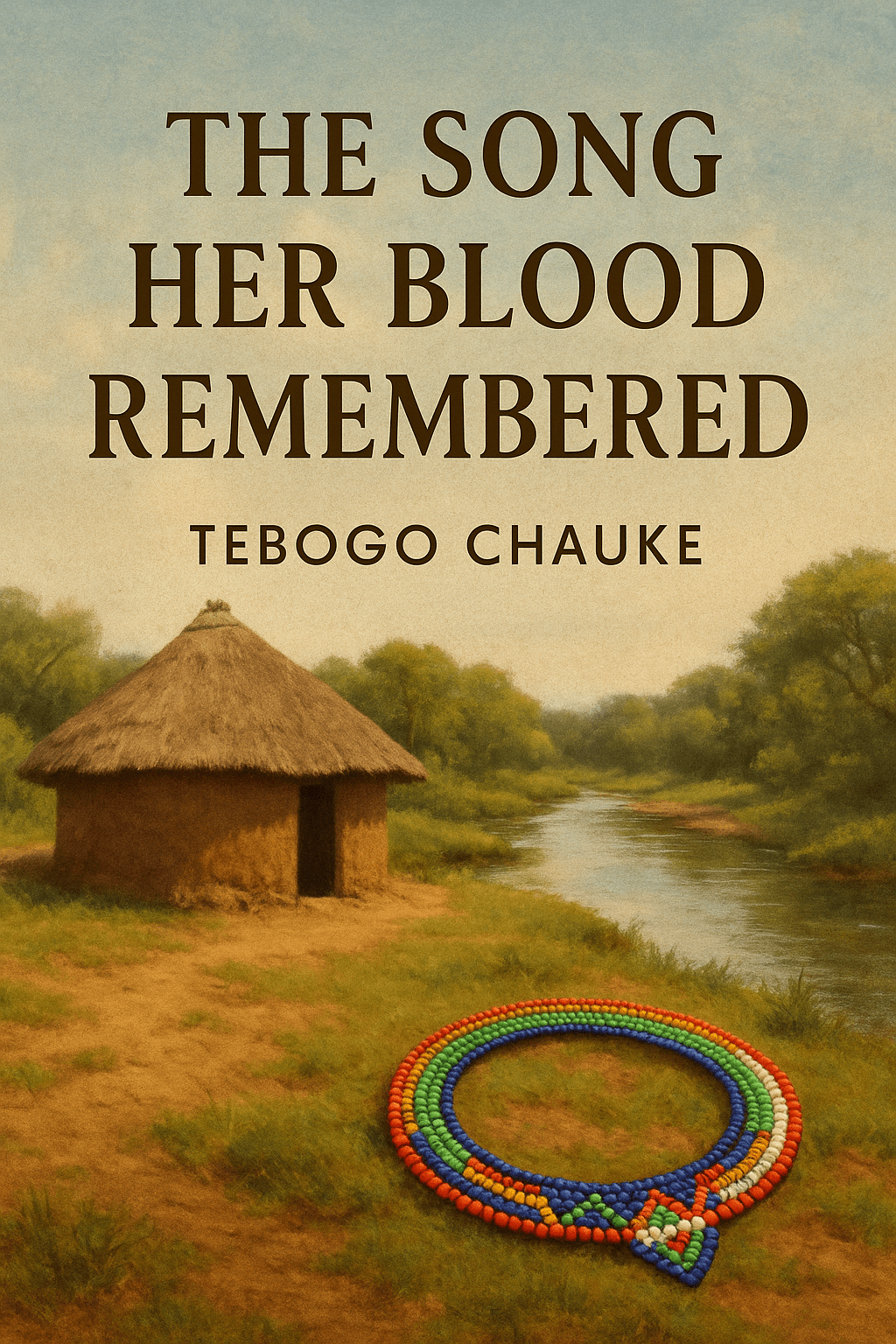
The Song Her Blood Remembered is a story of memory and return.
Nosipho, born from longing and prophecy in the village of Umzimkhulu in Kwa-Zulu Natal. When her mother Jola, falls mysteriously ill during pregnancy, a sacred thread begins to unravel. As Nosipho grows, an ancestral song stirs within her, a quiet call to heal, to remember, to return. Guided by a healer named Eseu, she journeys through spirit, silence, and the stories buried in her blood. What begins as a daughter’s search for healing becomes a reckoning with legacy, love, and the power of what we carry within.
COPYRIGHT AND PUBLISHING
Copyright © 2025 by Tebogo Chauke All rights reserved. No part of this publication may be reproduced, distributed, or transmitted in any form or by any means — including photocopying, recording, or other electronic or mechanical methods — without the prior written permission of the author. Cover Design: AI collaboration with author direction Interior Design & Formatting: Tebogo Chauke Published in PDF format by the author For inquiries, permissions, or speaking engagements: 📧 [madumelane84@gmail.com]
WHEN THE ANCESTORS SING, EVEN SILENCE LISTENS.
Nosipho was born just before sunrise, when the mist still held secrets and the birds had not yet made peace with the morning. In the quiet hills of Umzimkhulu, where the river curved like a sleeping child, her cry pierced the dawn like a promise kept too long. Her mother Jola, wept not from pain but from gratitude so heavy it bent her forward like prayer. Years had passed like shadows chasing her womb, each season bringing hope and empty arms. And then, finally, Nosipho, the gift. Langa, her father, knelt beside them both. He was a man made of patience and soft strength, the kind of man whose presence made even stubborn cattle obey. He had waited not just for a child, but for this child, born of love, longing, and a village that had never stopped believing. Umzimkhulu welcomed Nosipho like a sacred drumbeat—here, at last. The elders ululated, the midwives poured river water on her feet, and the healer, Eseu, stood silent at the doorway, eyes closed, lips moving in a language older than language. "Mark this child," he whispered. "She is born with a song in her blood."
THE BODY BREAKS IN SILENCE BEFORE THE SOUL BEGINS TO SPEAK.
Nosipho grew up where laughter and fire smoke curled into the same sky. She ran barefoot on red soil, her joy louder than the goats, her spirit brighter than the midday sun. She was the kind of child who spoke to trees and believed they whispered back. Her hair was always untamed, her feet always dirty, her smile always honest. But behind the laughter, there was a quiet truth beginning to take shape.
Jola, her mother, began to fade slowly, like smoke from a snuffed flame. Some days she was bright, walking through the fields with Nosipho’s small hand wrapped in hers, singing old hymns with a voice that danced. But other days, she lay still, her breath shallow, her eyes distant as if listening to something no one else could hear.
Langa became two parents in one body. He cooked, bathed, braided tiny plaits into Nosipho’s hair with trembling fingers. He carried Jola in his arms when she was too weak to stand, whispering strength into her ear like prayer. And when he was tired, he did not speak of it. He simply went on.
The women of Umzimkhulu did not let him walk that path alone. Mama Zodwa brought herbs. Gogo Neli rocked Nosipho when the fever took Jola. Auntie Pumeza came with sour porridge and quiet songs. They didn’t ask for thanks, they simply came because that’s what the village does.
Eseu, the village healer, watched quietly. He came when he was called, laid hands gently on Jola’s back, burned dried roots and listened to the smoke. But even he could not name what was wrong. “Not yet,” he said one evening as Langa stood beside him, hopeful and hollow. “They have not shown me so we must wait for the ancestors to speak.”
And so, they waited. And Nosipho grew. She didn’t yet know that her mother’s sickness had something to do with her. That sometimes, birth is not just a beginning but also the unearthing of something that was buried long before.
The first time Nosipho noticed the silence in her mother’s eyes, she was six. It was a morning like any other, the sun yawning over the hills, roosters declaring their importance, and the river humming softly in the distance. Jola was sitting outside, her hands idle on her lap, staring into the space between things. “Mama,” Nosipho said, offering her a string of wildflowers she had tied together with shaky fingers. Jola smiled, but it did not reach her eyes. “Thank you, my love,” she whispered, taking the flowers but not holding them. Her hands trembled slightly, then stilled again like a bird hiding its broken wing. Nosipho watched her mother carefully that day. The way she moved slower. The way she forgot to hum while peeling vegetables. The way she winced when lifting the kettle. She didn’t ask questions, not because she didn’t want to, but because children born in villages know that some truths walk without shoes and should not be chased.
But the questions grew with her, quiet, sacred questions she carried like stones in her pocket.
One evening, she overheard Gogo Neli speaking softly to Langa under the marula tree. “The girl is marked, Langa. It’s not the mother alone. We feel it. All of us.”
“She is a child,” Langa said, his voice steady but tired. “My child.”
“That may be true,” Gogo replied. “But she did not come alone.”
That night, Nosipho lay awake, staring at the thatched roof above her head, wondering what it meant to not come alone. She remembered the dreams, those strange dreams where she walked beside women with painted faces, their voices chanting in tongues she could not yet understand. She remembered waking with her hands pressed to her chest, heart racing like a drum. And still, she said nothing. She watched. She waited. Just like Eseu.
IT HAPPENED ON THE NIGHT OF THE RIVER FIREFLIES.
The moon was swollen and golden, hanging low like it had come to listen. Nosipho had slipped out while everyone was asleep, drawn by a whisper in her bones that she could not explain. The river wasn’t far, just past the mango trees, beyond the stones where children left offerings during harvest season.
She sat at the edge of the water, toes dipped in the cool stream, watching the fireflies gather. They blinked slowly at first, like shy stars, then more boldly dancing in patterns that felt familiar.
She hummed a song her mother used to sing when she was well. It was an old tune, older than words, something passed from womb to womb. As she hummed, the fireflies moved closer. They circled her, above her, around her and she wasn’t afraid, only still, like the earth when it’s listening.
And then, just for a moment the water rose. Not in waves, not in force. It lifted, curled toward her like a hand reaching out. A small splash shimmered in front of her and in it, she saw a face—not her reflection. A woman. Dark-skinned, braided hair wrapped in beads. Her eyes were closed, her lips moving, but the words did not reach Nosipho’s ears. She blinked and the face was gone. The fireflies scattered, the water stilled and Nosipho sat there, heart pounding, breath caught. When she returned home, her mother was awake, sitting while waiting. “You saw her?” Jola said softly, not looking at her. Nosipho nodded, trembling. “I think… I think she was calling me.” Jola closed her eyes, tears slipping down her face. “It has begun.”
The next morning, before the sun had fully climbed the sky, Langa saddled the old donkey cart and helped Nosipho climb in, wrapped in her mother’s old shawl and they both took the road to Eseu’s homestead. The road was long and dusty, winding past fields of maize and the graves of those who came before. Nosipho didn’t speak, she didn’t need to. Her dreams had been filled with the face again, this time humming the same song she sang by the river. Eseu’s home sat at the edge of the village, where the wild bush began, where stories were still carried by the wind and trees whispered names you hadn’t spoken in years. Smoke curled from his hut as they arrived, and before they could knock, he opened the door. “I felt her coming,” he said, his eyes never leaving Nosipho’s. “Come in, child of rivers.”
Inside, herbs hung from the ceiling, drums rested near the mat, and the scent of burning mpepho clung to the air like prayer. Nosipho sat where he pointed, knees tucked under her, fingers tangled in the ends of the shawl. Eseu didn’t speak, he poured water into a calabash, whispered into it, and then placed it between them. He stared into the water, and Nosipho felt the
room shift like everything slowed, thickened. “She is being called,” he said finally. “Not to the ancestors—but through them.” Langa frowned. “What does that mean, Mkhulu?” he said “She carries a memory not hers, a promise made before she was born”. Nosipho’s breath caught. “What must we do?” Langa asked. Eseu looked at her but not as a child, as something ancient. “She must listen”. There is a path opening, and only she can walk it. But the way will not be smooth. Some spirits will guide her. Others will test her.”
“And us?” Langa asked.
“You must protect her, but do not shield her. There is a difference.”
He stood slowly and reached into a carved wooden bowl. From it, he pulled a red string and tied it around Nosipho’s wrist. “This is not protection,” he said. “It is remembrance. When the world starts to blur, this will remind you of who you are.”
Nosipho looked down at the string, feeling its weight far beyond what it was.
“She will return when the dreams deepen,” Eseu said, already turning back toward the calabash. “For now, let her live. Let her feel everything.”
Outside, the wind rustled through the dry leaves. Inside, a journey had begun. Back in the village, the days moved slowly, like smoke curling from a cooking fire. But Nosipho was no longer the same girl who had left that morning. Something had shifted, quietly but deeply, like a river changing its course beneath the soil. She returned to her chores of fetching water, helping with the goats, pounding maize but the world now whispered to her in strange ways. The trees seemed to lean closer when she walked past. The wind sometimes carried words she didn’t understand. At night, the stars blinked with a kind of urgency, like they had something to say.
Her mother, Jola, was having a good week. The sickness that stole her strength often came and went like the tide, but for now, she was lighter, smiling more. Nosipho stayed close to her, sitting beside her as she worked with her hands, massaging her legs with warm herbs, brushing her hair as the sun set behind the hills. “Ngiyabonga, mntwanami,” her mother would whisper. “Your hands carry peace.”
But Nosipho was starting to notice things. Small things. Like how her mother’s shadow didn’t always fall in the same direction as her body. Or how, at night, when Jola was asleep, Nosipho could hear two voices breathing, one hers and one older, raspier, and somewhere deep within the room. The dreams began again, more vivid this time. She was walking through tall grass, barefoot, and the earth pulsed under her feet like a drum. A woman stood in the distance, wearing red beads across her chest and a wrap of brown cloth. She never spoke but she pointed to the sky, then to the river, then to Nosipho’s chest.
One night, after a dream that ended with the woman placing a stone in her hand, Nosipho woke up to find her fist clenched tightly. When she opened it, nothing was there but her palm tingled, warm and aching, like something had once been. She didn’t speak of it, not yet, not even to Langa but the wonder had begun. The veil between worlds was lifting slowly, like dawn on a misty mountain and Nosipho… was watching.
IT BEGAN WITH A SOUND SHE COULDN'T EXPLAIN.
Nosipho had gone to fetch firewood in the early afternoon, walking past the thickets behind the kraal an area she’d always known, always trusted. The birds were singing, the sky a soft dome of late summer blue. But there was a hum, low, vibrating just beneath the usual music of the earth. It came not through her ears, but through her bones. She paused, gathering the sticks more slowly now. Her breath felt counted, as if each inhale had a watcher.
Then she saw her, not the woman from her dreams—but something else.
A figure, seated beneath a wild fig tree, her back straight and eyes closed. She wore a cloth the colour of rusted earth, and her hair was wound in intricate coils. Around her neck hung bones and beads, charms that clicked softly in the windless air. A small fire burned in front of her, but there was no smoke.
Nosipho’s feet stopped moving before her mind caught up. The woman opened her eyes. They were the colour of ash, and yet glowing with something ancient. She tilted her head slightly, as though she'd been waiting. “You are late,” she said in a voice that was not a voice but more like wind brushing stone. “I don’t know you,” Nosipho whispered. “You don’t know yourself yet,” the woman replied. “But you are walking home. Slowly, yes. But home.” The fire hissed once. A bird shrieked high above them.
“Your mother is only the doorway. But you... you are the return. They have waited for you.” Nosipho stepped back, heart pounding. “Who are you?”
The woman rose with ease, as if weightless. She stepped forward, her presence both terrifying and familiar. “I am what Eseu will not tell you yet. I am what your blood already sings. When the river calls your name, you will come.”
Nosipho blinked,
And she was alone again.
No fire, no woman, no sound, but the wind picking up as though it, too, was trying to speak. She dropped the wood and ran. Her heart galloped ahead of her feet, thudding wildly as she tore through the village path, the bundle of wood forgotten in the dust. She didn’t greet anyone, didn’t stop for the goats crossing, or the children playing on the side of the rondavel.
She ran like she was on fire. Like she was being chased by something ancient and invisible.
br
Eseu’s homestead sat slightly elevated above the village, nestled between two large boulders and framed by a cluster of medicinal trees. The smoke from his small hut coiled upwards like a snake whispering to the heavens.
Nosipho didn’t knock. She burst through the reed door, breathless and wild-eyed. Eseu seated on a grass mat, surrounded by his bones, herbs, and quiet knowing, didn’t flinch. He looked up slowly, as though he had been waiting. “You saw her,” he said, before she could even speak. Nosipho froze. “How did you—?” “There are no secrets between the bones and the wind,” he murmured. “You were called.”
“I don’t understand,” she said, voice cracking. “She said… I’m the return. That my mother is a doorway. That they’re waiting.”
Eseu nodded solemnly. “And so they are. You were not born just to live, Nosipho. You were born to remember.”
Tears stung her eyes. “But I don’t know anything. I don’t know what she meant. Why now?”
“Because the time of silence has ended,” Eseu replied, rising to stand before her. He took a pinch of snuff, exhaled it toward the ground, and whispered a
word in a language older than memory. “You must begin the walk,” he said. “Not with your feet, but with your spirit. Tonight, we prepare. Tomorrow, the ancestors will speak.” Nosipho swallowed her fear. Somewhere deep inside her, beneath the terror and the confusion, something had started to stir, a strange peace, the echo of something ancient. She was not ready but she would go because some journeys don’t wait for you to be ready. The sun had long dipped behind the hills, the sky cloaked in purple shadows. In the yard of their small home, Langa paced with quiet worry, pausing now and then to peer down the path where Nosipho should have returned hours ago. Inside, Jola lay curled beneath her woven blanket, her breath uneven, her skin damp with the night’s humidity and something older, something hidden. “She’s never been this late,” Langa muttered, more to himself than to Jola. “She’s not lost,” Jola whispered from her bed, voice frail but certain. “She’s where she was always meant to be.” Before Langa could respond, a soft knock landed on their door, a young boy from the next homestead stood barefoot and breathless. “My father sent me. He said to tell that Nosipho is at Eseu’s place. He said the ancestors called her.” The message struck like thunder. Langa closed his eyes for a long moment. He had known. Deep down, he had always known. The way Nosipho sometimes stared at fire like it was speaking to her, how she’d wake from dreams with her fists clenched, crying names she’d never been told. But knowing didn’t make it easier. Love never does. Inside, Jola wept. Not because her child had been taken, but because her child had been returned. The time had come. She reached for Langa’s hand, her grip weak but urgent. “There’s something you must know.” He turned to her, his strong face crumbling at the edges. “I was warned,” she said, “before I ever conceived her. I was told that the price of bringing her into the world would be my own body. That I would be the gate through which something ancient would return. I agreed because I wanted her. I needed her. But I didn’t know the pain would last this long.” Langa sank beside her, tears brimming. “You should have told me.” “I couldn’t,” she said softly. “Because I didn’t know how to carry it and still be whole. But now, now we must prepare. Because she will return not as a child, but as a bridge between worlds.” And while they cried together, somewhere in Eseu’s sacred hut, Nosipho knelt before the fire. The bones had been thrown. The chants had been sung. And in the flicker of the flame, the ancestors began to speak: “You were born of a vow. A healing that required blood. Your mother bore the sickness not because she was weak but because she made the greatest sacrifice. Her body became a passage for you. And now, you must remember. You must walk. ”Nosipho felt the words root into her spirit. She didn’t know yet what the journey would ask of her. But for the first time, she wasn’t afraid. The candlelight in the small round hut trembled as the wind outside picked up, whispering through the cracks. Inside, Jola’s breath had grown shallower, but her voice carried a strength that hadn’t been there in weeks. She had released the truth that had weighed on her for so long. The vow.
The price. The sickness that came not from illness, but from the ancestors' claim. Langa held her frail hand tightly, silent for a long time. The warmth of it, fading. Her confession wrapped around him like a fog familiar, but still suffocating. Then, with eyes that held both tenderness and pain, he said, “I have something too, Jola.” She turned her head slowly, surprised by the heaviness in his tone. “You’re not the only one who made a vow.” He stood up, walked over to the corner of the hut where his father’s walking stick leaned, blackened by age, carved with symbols no one ever spoke about. He brought it forward, placing it beside her bed like an offering. “When I was a boy,” he said, voice low and steady, “I was chosen too. But I ran. I left the calling behind. I chose the life I thought I could build instead of the one I was born into. My father warned me, that if I denied the path, it would find its way through my bloodline. He said the gift would skip me… and land where it was most needed.” Jola’s eyes widened. “Nosipho…” He nodded. “She was never just ours. She is ours and theirs. I’ve always known. I just didn’t want it to be true.” Silence folded between them, thick and sacred. “I thought if I worked hard, stayed kind, loved you fully then it would be enough,” Langa whispered. “But the ancestors never forget. And now they’ve returned for her.” Tears traced Jola’s temples as she reached out, touching the walking stick with trembling fingers. “So our child is the sum of both our promises.” “And both our failures,” Langa said gently. “But maybe also our redemption.” Outside, the wind hushed. The ancestors had heard. Their child had returned to Eseu. And now, the path was fully awakening beneath her feet. They walked at dawn, before the sun had spilled gold over the hills of Umzimkhulu. Eseu’s steps were steady, rooted deep like an old fig tree, and Nosipho followed barefoot, each step pressing questions into the earth. They didn’t speak much, not at first. The path led through the heart of the forest, where the air grew thick with memory and leaves whispered names she had not yet learned. Birds sang unfamiliar songs, and now and again, Eseu would stop, pressing her palm to the bark of a tree, or scooping a handful of red soil to let it run through her fingers. Everything was language. Everything was alive. “This place,” Eseu finally said, “is where your grandmother heard her first calling. The cave is up ahead. We go there not to seek power, but to remember.” They reached a small cave shaded by thick vines. Inside, smoke lingered from old fires, and the scent of mphepho hung in the air. Eseu prepared the space quietly, lighting herbs, drawing symbols in the soil. Then he turned to Nosipho and said, “Tonight, you will not dream. The ancestors will speak while you are awake.”
AND THEY DID.
The fire flickered, and in its dance, Nosipho saw visions of her mother as a young girl, weeping into her hands; her father burying something deep beneath a tree; a woman she had never met, holding her in the stars. Eseu placed her hands on Nosipho’s shoulders. “You are not only your mother’s daughter. You are the echo of many women, the song your blood remembered. You will return home with eyes that see more than truth and they will see pain, sacrifice, and healing. You must choose all of them.” They stayed near the cave for seven days. Eseu built a small hut from reeds and earth, and together they lived as the old ones had, simple, silent, listening. On the second night, they bathed in the river under moonlight. Eseu whispered chants that made the water shimmer, and as Nosipho stood waist-deep in the current, she felt it, an unseen hand brushing her spine, the river cradling her as if it knew her name before she was born. “The water remembers,” Eseu told her. “When you call, it answers.” By the fourth day, Nosipho began to hear sounds she couldn’t explain, bells when there were none, a flute playing inside wind, her own name whispered by birds. She woke before dawn to sweep the earth with traditional brooms, preparing the ground for the morning rituals. Each motion was a conversation with those who came before her. Eseu taught her the songs, the slow sorrowful ones for grieving, the deep-toned chants for summoning, and the soft lullabies that only a gifted child could understand. “These songs,” she said, “aren’t sung with the mouth. They rise from the bones.” On the sixth day, they walked to a clearing where a circle of stones stood. It was where the test came. She was told to sit in the centre of the stones alone, without food, fire, or water, until nightfall. “You must learn to sit in silence even when your heart screams,” Eseu said. “This is where many run. If you stay, they will come.” And they did. As the sun sank, shadows gathered. Nosipho felt her chest tighten, her eyes blur. Then, the ground beneath her seemed to hum, and spirits came, one by one, not to frighten her, but to pass on pieces of themselves. A healer’s hands. A warrior’s courage. A mother’s endurance. A seer’s knowing. When it was done, she collapsed, not from fear but from the weight of remembering. Eseu found her at dawn, weeping quietly, the morning dew clinging to her skin like a second baptism. “You are ready,” he said. “Now go home. They are waiting for you.” As Nosipho stepped into the village, it was not her feet that touched the soil first but her shadow, long and cloaked in knowing. Children paused their play. Elders stood silently beneath shaded trees. The wind that stirred the dust recognized her. Langa had been waiting at the gate. His eyes, once filled with a quiet joy, now carried a weight too heavy for words. Behind him, the house was quiet, too quiet. And then came her mother’s cry from inside. A cry not of pain, but of memory returning to the bones. They embraced, father and daughter as his hand lingering on the back of her head as if afraid she’d vanish again. “Your mother is not well,” he said, though she already knew.
Inside, Jola was thinner, paler, but her spirit burned stronger than ever. She lifted her eyes to meet her daughter’s and smiled as though she was looking into a mirror that finally reflected truth. “You went to Eseu,” she whispered. “I had to,” Nosipho replied, kneeling by her side. But before Jola could speak, Langa sat down too, folding his arms. There was something trembling beneath his calm. “I have something to tell you both,” he said. “Before she does. Before you carry this alone.” Jola reached for his hand surprised, even now. He nodded gently. “I was not born in Umzimkhulu,” Langa began. “I was found and taken in by a sangoma who raised me until I was sixteen. That’s the man I called my father. He was, he is because he raised me. He said I had the mark, the gift. But I ran. I chose to have a family over the calling. I buried it. But when you were born, Nosipho, I saw it return, not in me but inn you. Nosipho’s eyes did not blink. She sat, silent, holding both of their truths like clay waiting to be shaped. Now Jola spoke. “I was told by Eseu before you were born that this child would be my healing and my undoing. That to carry her would awaken what I buried in my blood. I did not believe it. But from the moment you came into my womb, something in me shifted. I was never the same.” She coughed, weakly, and Langa held her shoulder. “They were right,” she said, “but I understand now. You are not the end of us, Nosipho. You are the bridge.” And in that moment, for the first time since her return, Nosipho wept, not from grief but from becoming. That night, Nosipho could not sleep. The walls of her childhood home felt closer than they ever had, as though they too leaned in to listen to her breath, her becoming. Outside, the moon was full, resting like an ancestral eye above the hills. And as the wind swayed through the long grass, she heard them again, the ones who had spoken to her in the forest. Her ancestors. She rose before the sun. Wrapped in ibayi (a cloth) made her way back to Eseu’s homestead. It was time. Eseu had been waiting. He stood in front of the sacred fire, already burning, already knowing. Around them, bones of animal, bowls of water, herbs, and skins of goats and cow. A drum began to sound in the background, low, steady, like the heartbeat of the land itself. “You have returned with truth in your bones,” Eseu said without turning. “I want to learn,” she answered. “I want to heal.” He looked at her now, and for the first time, bowed his head. “Then we begin.” The weeks that followed were filled with rituals and riddles. Nosipho learned the language of dreams, how to read smoke, how to listen to the silence between sounds. She walked barefoot in the river where Eseu taught her how water remembers everything. She climbed hills where she fasted, alone, guided only by drums she could not see. Her dreams grew deeper, visits
from women wrapped in beads, old men who spoke in riddles, and children who brought her stones that glowed like fire. Some dreams made her cry. Others made her tremble. But all of them pulled her closer to her gift. She healed her first wound—a boy who had lost his voice after a nightmare. She spoke with a woman who dreamed of drowning and woke up dry, but dying. With Eseu’s guidance, she found the reason. She spoke the names. The woman wept, then healed. Nosipho began to feel it, the weight of her name and the song in her blood. One afternoon, Eseu handed her a small mirror made of bone and said, “When you can see yourself through this, not your face, but your spirit then you are ready to return. To heal not just stranger but your own bloodline.” That night, she saw it. Not her reflection. But her mother, strong and young. Her father, drumming beneath a tree. Herself in skins, beads, standing before a line of women stretching back into time. Eseu led her deep into the forest, further than she had ever gone before. The sun was shy that day, hidden behind clouds that whispered rain songs. They walked in silence. No words were needed. The journey itself was the teaching. They arrived at a clearing encircled by ancient trees, thick-trunked, moss-covered, their roots entangled like old stories. In the centre stood a flat stone altar, darkened by time, and beside it a wooden bowl filled with river water and ash. “You must sit here until the ancestors speak,” Eseu said gently. “Alone.” “How will I know they are speaking?” “You will not doubt it, “and then he left her. For hours, the forest wrapped itself around her. First came the heat, her own fear rising like steam. Then the cold, a silence that gripped her spine. Then came the visions. She saw her mother, Jola, younger, standing at a river, offering something wrapped in red cloth to the water. She saw Langa, as a boy, burying a bundle beneath a tree while two old women watched in the distance. She saw herself, born of all these secrets, glowing like dawn. She wept. Not because she was afraid but because she finally knew. Her gift was not just for healing wounds. It was for revealing the truth. The wind picked up. The trees swayed. The water in the bowl began to move, spinning slowly until it stilled and when she looked in, she saw not her face, but a lioness, INGONYAMA. Strong. Unmoving. Watching. Then, from the shadowed edge of the clearing, Eseu’s voice came: “Now you are no longer the girl who wondered. You are the woman who remembers.” He walked to her and placed a single red string around her wrist. “When you return home, do not fear what you find. The ancestors will walk before you, beside you, and behind you.” She rose slowly, steadier than she had ever been. Nosipho was ready to return home and not just as a daughter, but as the one sent to heal what had been broken.
They heard the footsteps before they saw her. Langa looked up from the stool where he’d been sitting all afternoon, unable to rest. Jola, thinner now, her skin like folded linen, lay propped against cushions, her breath shallow but her eyes sharp. When Nosipho stepped into the yard, it was like the wind paused. Even the chickens that clucked daily around the mango tree seemed to grow still. Her father rose first. His breath caught in his chest, not from surprise, but from recognition. She was not the same girl he had kissed goodbye. Something ancient moved in her eyes now Jola reached for her daughter with trembling hands. “You are back.” Nosipho knelt between them, resting her palms on the ground before their feet. “I have come to listen. And to speak.”
THAT NIGHT, THE HOUSE DID NOT SLEEP.
Jola began her story, voice cracked by illness and time. She spoke of the long ache for a child, the rituals performed in silence, the desperate visit to a forgotten healer who promised life in exchange for secrecy. The price: the child would belong not only to them, but to the ancestors. And if ever they broke the path meant for her, the sickness would return and not to kill her, but to remind them. Langa listened, eyes wide not with shock, but grief. He waited until Jola had said all she could say, then stood slowly and said, “There is something else.” Nosipho looked up. He confessed a lineage never told. His great-grandmother had walked with the calling. His grandfather had rejected the calling. His father denied the blood and he, fearing the same for his daughter, tried to build a life far from rivers and spirits, hoping she would be free. “But no one runs from what is in the bones,” he said softly. “It finds you.” Nosipho did not cry. She simply nodded. “I know now,” she said. “I was never meant to be kept from it. I was born to return to it.” That night, in the room where she had first taken her steps, Nosipho sat between her parents, and together they prayed, not just for healing, but for release. The kind that comes when all the pieces of the truth are finally laid bare. Outside, a soft rain began to fall. The ancestors had heard.“I REMEMBER EVERYTHING NOW”,
The taste of the river water Eseu gave me that day, the way it burned and cooled at the same time. The way my mother’s voice cracked when I returned home and she said my name like it was both a question and an answer. The way my father couldn’t meet my eyes, not at first, not until I touched his hand and said, “I know.” I remember the stories the ancestors whispered in my sleep. The forgotten names they placed on my tongue. I remember learning how to hear silence and feel what hasn’t yet arrived. I remember when the wind began to carry messages, and the fire began to speak.But most of all, I remember the love. The love that was waiting for me in the soil. In the bones of women who walked barefoot so I could learn to stand. In the men who bowed their heads to truth, even when it burned. I wasn’t born to be ordinary. None of us are. But I needed to walk the long road, to carry my mother’s pain, to witness my father’s reckoning, and to let go of the girl who only wanted to be held. Now, I hold others. Now, I speak for those who cannot. Now, I walk the path with the ancestors behind me, beside me, within me. And even though the road still rises and curves, even though I do not know what tomorrow brings, I do know this: the song my blood remembered will never be silenced again.