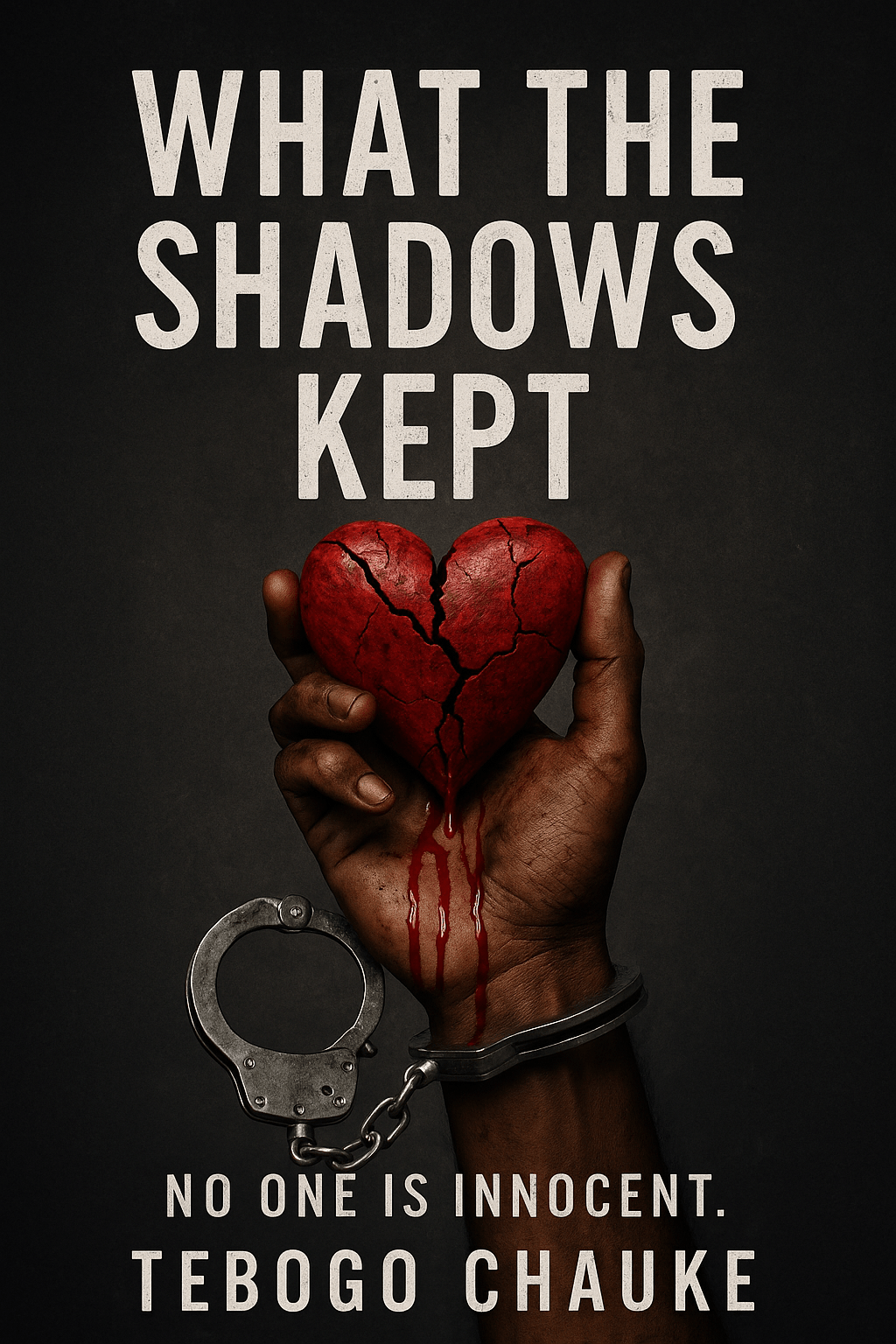
WHAT THE SHADOWS KEPT
No One Is Innocent Here
Author’s Note
This is a work of fiction. All names, characters, places and incidents are either the product of the author’s imagination or used fictitiously. Any resemblance to actual events, locales or persons—living or dead is purely coincidental. While the story may explore real-world issues such as crime, trauma, healing and justice, it does so within the bounds of creative storytelling. The intention is not to depict or reference any specific individuals or experiences but to delve into the complexities of human emotion, morality, and the choices we make in pursuit of truth and redemption.
Content Warning
This novel contains themes that may be sensitive or triggering for some readers, including: • Violence and murder • Psychological trauma • Human trafficking • Grief and loss • Betrayal and moral conflict While every effort has been made to handle these themes with care and compassion, the story delves into the darker complexities of justice, vengeance and healing. Reader discretion is advised. Your wellbeing matters more than any page.
COPYRIGHT AND PUBLISHING
Copyright © 2025 by Tebogo Chauke
All rights reserved. No part of this publication may be reproduced, distributed, or transmitted in any form or by any means — including photocopying, recording, or other electronic or mechanical methods — without the prior written permission of the author. Cover Design: AI collaboration with author direction Interior Design & Formatting: Tebogo Chauke Published in PDF format by the author For inquiries, permissions, or speaking engagements: 📧 [madumelane84@gmail.com]
Prologue
The rain hadn’t even started when the first bullet hit the windshield. A crack, a warning, not enough to kill but enough to promise what was coming. Laubscher didn’t flinch. He gripped the steering wheel tighter and kept his eyes on the dirt road ahead. Beside him, Percy bled into the leather seat, barely conscious. They were almost there. The place they were driving to does not exist on the map. It was a name whispered once at a funeral then vanished into smoke. It smelled like dust, rusted metal and secrets left to rot. When they arrived, there were no gates, no guards, only an old kraal and a red scarf hanging from a tree. That was the sign. The moment they crossed the invisible threshold, Laubscher knew they weren’t in charge anymore. Inside, the room was colder than outside. Concrete walls, one dim light and a chair too clean to be trusted. Percy was dragged out, his feet scraping, his face vacant. No words, no mercy, not even a question. He was beaten slowly, methodically, not for answers but for betrayal. He had let Dorah and Prudence get caught. He had panicked and now, he had to pay. Laubscher was next. But his punishment was not with fists. It came in the form of a file, thick and bound in leather with his name printed in gold. Inside were his secrets. Every bribe, every favour and every lie he told himself to sleep at night. And Rikhotso, his commander and friend was the man who ordered the attack on the police station, the man who buried the cases and made him believe he was clean when he was already drowning. “You work for us now,” they said. “Or your family dies.” By the time they let him leave, Laubscher wasn’t the same man. He had memorized the new names. The drop location, the next judge to be silenced, the shipment date, the lie he’d have to tell Gauta and the cost of hesitating. But what no one saw coming… was the vault. And what was inside it. Back in the city, Gauta Motshabi lit a cigarette with trembling hands. The case files weren’t making sense anymore. Too many names. Too much blood. The foundation. The bodies. The whispers of a storm. Daniels was watching her closely now. She had questions and Gauta had ghosts. They thought they had buried the truth with the girl in the field. They were wrong. The shadows remembered everything. And this time, no one was innocent. Not even them.
Chapter One
They found a paper folded into a perfect square, tucked beneath Laubscher’s empty whisky glass and a half-burned candle. Gauta was the one who spotted it first. She always had an eye for the things people tried to hide when they were scared. The handwriting was tight, slanted as if it was written in haste and fear. One line: “I had no choice. I had to see the shipment off. – L.” They had already missed him by hours. The airport surveillance showed Laubscher moving like a man already dead, he maintained no eye contact, no hesitation. His wife walked two steps behind him with their son between them, and they carried only three bags and a no return tickets. But there were two men in dark coats. In a fleeting moment, Laubscher looked back as if he was realizing something but it was too late. The men redirected them through a restricted terminal and just like that, they vanished. Daniels stood beside Gauta in the CCTV room with her arms folded and jaw clenched. “They never made it on the plane,” she said quietly. “No,” Gauta replied while pulling the USB from the monitor. “But he left us breadcrumbs.” They followed the note to the edge of the rail yard, where the trucks moved like ghosts, slow and mostly unmarked. The shipment whispers had suggested untraceable drugs, children and stolen organs. Those were speculation until now. They didn’t know which truck or container or what exactly they were looking for, and yet, the deeper they went, the more they found. A clipboard was left behind, a manifest with altered signatures and a second warehouse registered to a dead company under a judge’s name. Daniels froze. Her hands shook as she stared at the document. Gauta stepped closer. “You okay?” Daniels nodded too quickly. “Yeah. Just… just piecing things together.” She didn’t tell the truth, not yet. Not that her boyfriend had started pulling away. Not that his questions had become cautious and strategic. Not even that he’d asked her point-blank what she knew about “the Foundation.” She was scared, not for herself but for the part of her that still wanted to believe in him.
Across town in a dim apartment above a failing bar, three men argued in thick whispers. One of them was bleeding. “You were supposed to handle the judge!” “I did. But his wife—” “Then kill her too.” “No, not yet. We need her signature for the land deed.” “Damn it. This is falling apart!” The middlemen were beginning to panic. The broker had gone silent. Anesa wasn’t returning any calls. Percy was presumed dead or close to it. The old structure was crumbling. No one knew who was really in charge anymore. So they turned on each other. Orders were lost. Payments delayed. Names were leaked. And somewhere, someone was watching it all burn. Back at HQ, Gauta stood before the whiteboard. The names were stacking up: Judges, Doctors, Politicians. Some already dead and some still waiting, but all of them connected. And in the middle of it, Laubscher’s voice echoed from the recording embedded in his final note: “I know what you’re thinking but this is bigger than all of us. If you continue to dig, dig fast and don’t trust anyone. Not even the ones you love.” The room fell silent. Gauta’s phone buzzed with unknown sender: “Check the vault before they do.” Daniels stepped closer. “What vault?” Gauta met her eyes. “One only Rikhotso could access.” She exhaled. “So it’s like that.” Gauta nodded. “We’re not just fighting criminals,” she muttered. “We’re digging up a system designed to bury the truth.” And just like that, the chase began again.
Chapter Two
2:36 a.m. It started with a flicker on a terminal, no one was supposed to be watching it. An encrypted message landed in the internal inbox of an independent prosecutor with no subject line or body text, only an attachment titled: “DO NOT TRUST THEM.” Inside were photographs, scanned case files, handwritten memos from senior legal advisors, evidence of decades-long corruption, missing shipments, doctored autopsy reports, falsified psychiatric evaluations. There were names. Big ones of people in robes, people in uniforms, people on national TV calling for justice by day and selling organs by night. It was a leak and within hours, it lit the city on fire. Daniels hadn’t slept. She’d spent the night cross-referencing names from the leak with her private database, the one she’d started in secret months earlier. Now she had seven exact matches, including two judges involved in past child trafficking cases. One of them had ruled against victims’ families and three wrongful death suits, they are all conveniently tied to state-run facilities funded by the same NGO now sitting at the centre of their investigation. But that wasn’t what scared her. What scared her was the name at the bottom of the list. Joshua Pedi. Her boyfriend. Not his father but him. Gauta stepped into the makeshift war room. “Anything?” Daniels didn’t look up. “Too much.” Gauta stood behind her, silent, patient. Then, Daniels said it. “He’s part of it.” The words sat heavy in the air. “Who?” Gauta asked. “Joshua. My Joshua, Gauta. He’s part of it.” “You’re sure?” Daniels clicked open a file of a grainy surveillance footage showing Joshua entering the vault building. Not as a visitor. He walked with purpose and had a black bag in hand. The security officer didn’t even ask for ID. “I should’ve known,” she whispered. “The careful lies. How he always changed the topic whenever I mentioned the Foundation. His father wasn’t just covering up. He was grooming him.”
Gauta placed a hand on her shoulder. “You’re not responsible for the shadows they chose.” Daniels blinked, steadying her breath. “No. But I know where they lead.” Elsewhere, in a candlelit church basement masked as a community hall, the middlemen crumbled. One had been tortured by their own. A judge had vanished. Two doctors were found dead with suicide notes, with the same handwriting, same ink, phones wiped and their families warned. Panic was spreading. “Who leaked it?” one whispered. No answer. “We’re being hunted.” No denial. “There’s a mole.” No blink. Then an older man, his collar stained with blood and whisky, whispered: “No. There’s a reckoning.” Rikhotso was unravelling. The Minister’s call had come in too late, though not unexpected. The man had lied. Said he’d help Gauta and Daniels, he even promised them protection. Five minutes after they left, he’d called The Broker. Now Rikhotso sat alone in his office, staring at the list. His name wasn’t on it, but his niece had worked for the Foundation, his brother-in-law had received money. The threads were closing in now and Gauta was getting too close. He picked up the phone and dialled a secure line. “We have a problem,” he said. “They’re moving faster than expected.” “What do you want us to do?” came the voice. “Slow them down. Discredit them if you can. If not—” He didn’t finish. He didn’t need to. That evening, Daniels met Joshua at the café where they’d first kissed. He smiled when he saw her. Reached for her hand but she pulled away. “Where were you two nights ago?”
He blinked. “At home. You know that.” “You weren’t.” She slid her phone across the table. The footage played. His face didn’t change. She leaned in, voice low. “Tell me you were working undercover.” Silence. “Tell me you weren’t going to kill me.” This time, he flinched. Daniels stood. “Do not follow me. Do not call me. If I disappear, a file goes straight to Gauta and you’ll burn with the rest of them.” She didn’t look back, but she felt his glassy, empty eyes cutting into her spine. 9:23 p.m. An anonymous message hit the media: “There’s a vault hidden beneath the old courthouse. What’s in it will finish them all. Go there.” By midnight, the city buzzed with fear. The whispers were now sirens. The hunters had become the hunted, and in the smoke and silence of the unfolding chaos, one truth began to rise: No one is innocent.
Chapter Three
04:47 a.m. A scream, low, muffled, not from pain but fury. Then silence. They found the body two hours later behind the rail yard. It was one of the judges who had ruled against the orphans. His eyes were open, his hands burned and a tape recorder lodged in his throat. Daniels listened to the playback with trembling hands. “I sentenced them to silence them because I was paid to. I let the Foundation run its clinics and I approved every single one. God help me, there were children inside.” Gauta looked away. “I think we just found our first confession,” Daniels whispered. “No,” Gauta said. “We just found a warning.” By sunrise, they had two more names crossed off the board, dead before they could be questioned. Both by "suicide." Same brand of rope, same phrasing on the notes, same clumsy attempts to clean digital footprints. Someone was cleaning house and they were fast. Gauta moved quickly now, dragging files from hidden servers, unlocking Rikhotso’s backups and syncing cloud drives that were never supposed to be found. Daniels sat at her desk, tracing timelines, dates, birth records. The shipments were not just drugs, they were people smuggled through hospitals and hidden in containers, labelled as “biohazard.” There were intake logs, marked “deceased.” But some of the names reappeared in The Foundation audits three years later, alive, reclassified and repurposed. Daniels felt sick. “They were recycling them,” she whispered. “As if they weren’t human.” Gauta said nothing, she just clenched her fists and opened the next file. In a hotel suite across the city, Laubscher's wife stared out the window, hands wrapped around a steaming mug. Their son lay curled up on the bed behind her, still asleep. She hadn’t spoken much since they fled. Only moved when told. Only answered when necessary. But this morning, she broke the silence. “He tried to stop it.” The man watching her from the chair said nothing. “He said the shipment was the last one. That if he showed up, they’d spare us.” The man leaned forward. “And they did?” “For now.” “What was in the shipment?” She turned, eyes hollow. “Memories. Children. Blood. I don’t know anymore. Maybe souls.”
That evening, an explosion tore through a server room downtown. One of the offsite backups Gauta had just accessed was gone. Three dead in the fire that didn’t stop until the floor collapsed. Daniels sat in the back of the ambulance, hands burnt but intact. “They’re watching our every move,” she said, staring at the IV drip. Gauta nodded. “They’re bleeding faster than they can hide it.” But her eyes betrayed her fear. Midnight. An email hit the national broadcaster's newsroom. Attached were Blueprints, access codes, lists, names and one file stood out. It was titled: THE VAULT | Revision 3.7 – For internal eyes only Inside was a signed clearance by Commander Rikhotso. Authorization for “containment and silence protocols.” Surveillance logs of whistle-blowers. Photos of raids labelled “non-existent.” And then, a list of agents marked “compromised.” Daniels was on it and so was Gauta, Zwide and Lukhanyo. One name was blurred. The caption said, “Asset unrecovered. Status unknown. Dangerous if found.” 03:11 a.m. The safe house was too quiet. Daniels couldn’t sleep, not with the list still open on her laptop. Her name, bold, final stared back like an obituary. “Compromised.” She had spent years following the rules. Now she was a liability. Just like Rikhotso. Just like Gauta. She glanced at the encrypted flash drive sitting on the table, the one Gauta said she’d never open. The one Rikhotso left behind before his silence. She plugged it in. “If you’re seeing this, I’m already dead. I’m sorry, I was trying to build something clean, but you can’t build clean with dirty hands.” Then the video glitches—a flash of children strapped to hospital beds, steel beds. One girl with white eyes, mouth stitched shut and a boy trying to scream through gauze. Daniels slammed the laptop shut. By morning, the city's power grid flickered with three substations down, one hospital went dark. Gauta watched the alerts roll in, eyes wide. “They’re moving the assets,” she said. Daniels stood beside her. “Where?” “Someplace they think we won’t follow.” “And will we?” Outside the abandoned research site, the air was thick with ash. The kind that sticks to lungs, the kind that remembers screams. They stepped inside. Lights flickered, alarms long dead, a hallway full of locked doors and behind them: Files. Bones. Ghosts.
Late in the evening, Percy was found under the bridge, arms still chained above his head. His shirt clung to him, soaked in blood and sweat. His throat had been slit clean. His lips stitched shut like a message or a warning. Rikhotso had promised him immunity, promised protection but in the end, Percy had been handed over like a sacrificial offering to a system that devoured its own. He died knowing the truth and maybe, just maybe, that’s what killed him. Laubscher sat in a locked room that smelled of salt, mildew and old regret. He hadn’t seen his wife or son since the airport, they were separated. Taken. Now he was here, wherever here was at a house that felt too clean to be safe, somewhere along the Mozambique coast. The heat hung heavy, the air buzzing with insects and unspoken threats. No cuffs. No beatings. Just silence. And a hood over his head until a few hours ago. On the wooden table in front of him sat a burner phone with one number saved: Rikhotso. He hadn’t called it. Wouldn’t. He knew what it was, not an olive branch but a snare. They were keeping him alive for a reason. Leverage. Ammunition because they still needed Rikhotso. Laubscher turned to the cracked window. Outside, the sea moved like it didn’t know anything was broken. But inside, he remembered everything. The vault, the photograph of a girl in a red scarf, the same scarf that had hung from the tree when they took Percy, the files he was told to bury, the names he was told to forget, the orders: Stall Gauta. Distract Daniels. Keep them running in circles. But the leak changed everything. He hadn’t sent it. But he knew who might have and if she was alive…Then the reckoning wasn’t coming, it was already here. Rikhotso sat in his car outside a burned church. The roof had collapsed long ago. He wasn’t praying, he was just listening to the silence between thoughts. To the hum beneath his heartbeat, to the text messages that didn’t come. To breaths that now felt borrowed. He had made mistakes, too many and now, the ghosts were knocking. He had let Gauta get too close. She wasn’t supposed to get past the surface. She wasn’t supposed to feel. Daniels was supposed to break but she hadn’t and now, because of that damn leak, the whole thing was starting to burn from the inside out He had no way to reach Anesa no way to reach the Broker. No allies. No weapons. No plan. Only the slow tightening of a noose. He didn’t know who was watching him, only that someone was and right now, he was just a name on a list. A loose thread, just waiting to be found and sacrificed. Gauta hadn’t slept in three nights, not because she couldn’t but because she refused to. The team was unravelling. Daniels was silent. The media had taken the bait and the public wanted blood.
Gauta opened the file again. There — buried in metadata which was a symbol of an old Foundation insignia. Corrupted. Broken. Twisted. Not just a leak. A WARNING. Laubscher finally picked up the phone. His hands shook from fear and knowing that once he made this call, there was no way back. The line rang once, then twice. Rikhotso answered with nothing but breath and for a few seconds, neither of them spoke. Then, Laubscher’s voice broke through, low and raw: “They know. The leak wasn’t just a warning. It was a match and now everything’s on fire.” Rikhotso didn’t respond. “I stalled them for you. Lied to Gauta. Led Daniels around in circles. I buried names in blank folders, erased files, scrubbed drives. I made them believe they were chasing phantoms.” “You’re talking like a man who knows he’s already dead,” Rikhotso finally said. Laubscher exhaled slowly. “Because I am. I betrayed them, Rikhotso. Gauta, Daniels, the entire unit. I chose survival over the truth. You and I, we lit this fuse together but you let it run wild.” “You think this is penance?” Rikhotso exhaled. “We are done man, there’s nowhere else to hide. We led those two go wild and now everything is exposed. Right now, they are coming for us.” Then silence. The door opened in the background. Laubscher inhaled, one final time. “They're here.” The call ended with a single sound of a bullet. One bullet between the eyes and he was gone, done, dead. The phone fell to the floor.
Chapter Four
The safe house was quiet, the kind of quiet that pressed against the walls and settled in the lungs. Gauta sat at her desk, the room glowing in the half-light of a dying afternoon. Her eyes burned but she didn’t blink. The files were open, screens everywhere, threads crisscrossed, every lead dead and still no sign of Anesa or the Broker. But what caught her eye now was something smaller. Stranger. The IP address from the original leak. The metadata trails from the encrypted messages. They pointed to a quiet home in Sinoville. A suburb in the northern part of Pretoria, known for its family-friendly atmosphere and strong sense of community. Registered in the name of a woman who had never worked her entire life. The woman whose son was Daniels's boyfriend. Gauta stood up, her breath hitching. She didn’t need Daniels to confirm it. She already knew. Daniels hadn’t spoken all morning. She stood at the edge of their safe house balcony, eyes unfocused. When Gauta called her name, she didn’t hear her twice. “Daniels,” Gauta said again. Daniels turned slowly. “Yes?” “When last did you talk to Joshua?” Gauta asked. Daniels blinked. “I haven’t spoken to him since the last time I confronted him. Why?” “His mother’s name, is it Norah?” Daniels stilled. “Yes. Why?” “She sent the links.” There was a silence long enough to echo. “What?” Daniels whispered. “She sent the Foundation files. She was the leak or part of it. She’s the one who reached out anonymously from her house, Daniels. She used her Wi-Fi but tried to hide it, something cracked.” “Are you sure?” Daniels’s voice broke. “She did,” Gauta said. “Do you think it’s a trap or a cry for help?” Daniels collapsed into the chair behind her. “What is happening here?”
20:00 p.m. The night was thick with anticipation as Gauta, Daniels, Zwide, and Lukhanyo approached the modest house in Sinoville. The neighbourhood was quiet, the kind of quiet that felt unnatural. They moved with caution, every step measured. Inside, Norah sat alone, her hands trembling as she clutched a worn family photograph. The knock on the door startled her but she seemed to have been expecting it. Zwide and Lukhanyo entered first, their presence imposing yet gentle. Gauta and Daniels followed, the tension in the room was palpable. Norah looked up, her eyes red-rimmed. “I knew this day would come,” she said softly. “Are you alone?” Daniels asked “Yes, I’ve been hiding here for weeks.” She said with tears in her eyes. “I came here after everything was firstly exposed. My husband told me that if he doesn’t comeback home for just one night then I should consider him dead and run for my life. “ “But this isn’t running, Norah. You are basically endangering your life.” Gauta said. “I know, but I couldn’t allow myself to die with the truth.” They took her to the safe house, where she began to unravel the tapestry of secrets. “The house,” she began, “was our retirement dream. Bought by my husband. He was a good man, once. But the Foundation... it changes people. He was recruited after they found his weakness and threatened to expose him. With tears and shame on her face, Norah said: My husband cheated on me with a school girl and he couldn’t risk running his reputation and so when he refused their offer, they used that against him.” “So he saved himself by killing young girls?” Zwide asked with irritation in his voice. “No, yes, look….he didn’t agree at first, but after they killed his mistress he saw how serious they were. They told him her death would be on him and they will come for his family. That’s why I chose to tell the truth before they find me. I was not part of it and I couldn’t report them because they are the law and they would have killed me.” She paused as if collecting her thoughts. “My husband introduced Joshua to the Foundation not because he wanted to but because he was forced to do it. At the end, Joshua became the master behind the shipments and he worked with a man called Percy.” she turned to Daniels. “He dated you after finding out you worked closely with Detective Gauta. That was part of the plan, to
distract you and to protect the foundation. Joshua doesn’t love anyone, I’m sorry Daniels.” Daniels's face was a mask of shock and grief. The revelations were too much, too fast. Norah continued, “I sent the files, I had to. I couldn’t live with the guilt. I thought it might help you, but now... I don’t know.” The safe house was still, the weight of Norah's confession hanging heavy in the air. 2:45 a.m. The door burst open. Gauta was still at her desk, head bowed over flickering monitors when Zwide and Lukhanyo stepped in, rainwater glistening on their jackets, their faces carved with tension. “We stopped by the police station,” Zwide said, voice low but urgent. “Routine check… but this wasn’t routine.” He held up a sealed envelope with no stamp, no return address just a single line scrawled across the front: “To: The Team.” Daniels stood, her breath catching. Gauta took it from Zwide’s hand, fingers trembling just slightly. The seal tore open too easily, the paper already damp in spots from the night's storm. Inside it was a folded sheet of notepaper. Handwritten and ink smudged, the lines crooked like someone writing while glancing over their shoulder. Rikhotso. If you're reading this, it means I’m gone or close enough. I wasn’t brave, not like Percy. I stayed too long. Believed too much. But maybe this gets me clean. I never met Anesa or saw the Broker. Everything was through encrypted calls, code words, burner phones. But I heard them. I listened. I gave them access. I made sure no one found Percy’s body for days. That was my penance. Inside the USB, you’ll find logs. Shipment schedules. Medical transport manifests. Most of the names are fake but look closer. Cross-reference the meds listed with the hospitals still receiving Foundation funding. Look into the “Selbourne” files. That was the codename for the facility they never shut down, the one still active in the North. I think it’s where they moved the children. Tell Daniels… I know what I cost her and I’m sorry. They’re coming for me. I won’t make it. But maybe this will help you finish what you started. Gauta didn’t speak for a long moment. Then she turned to Lukhanyo. “Power everything up. Secure line. Zwide, isolate that USB. I want it scanned, mirrored and sent to the dark vault.” Daniels just stared at the paper, her throat dry. Her name… scribbled by a dying man who’d once smiled like he had no secrets.
The USB: “Blood and Blueprints” They worked in silence, each absorbed in the glow of their screens. The USB was basic, no encryption but booby trapped with hidden scripts. Zwide neutralized them, peeling layers of code like rot from an onion. Inside were folders marked with letters: V. M. L. S. and one named “SELBORNE_0.” Daniels opened it. There were floor plans. Maps. A video, grainy footage from an overhead drone. A compound, hidden in a mountain basin. High fences and security patrols. And a flag but not national. “The Foundation insignia.” “They’re still operating,” Daniels whispered. “They never shut this one down.” Medical logs showed shipments from various hospitals but one pattern stood out: every three weeks, unregistered ambulances travelled under the name “Cross-Hope Transport”, always returning empty. Lukhanyo ran the number plates and said. “It’s fake. But one of them was captured speeding near the Mozambique border three months ago.” “And the doctor who signed the cargo manifest,” Gauta added, “was reported missing a week later.” They moved fast, connecting names, falsified identities, front companies. Rikhotso had mapped an underground pipeline that fed from government hospitals to Foundation labs, skipping detection by using old apartheid-era supply chains and reactivating ghost facilities that had been marked “decommissioned.” And there, buried in an unmarked folder was a single audio file. They played it. The Broker’s voice. The voice was male. Filtered, distorted and almost ghostlike. “Rikhotso, if you want your debts cleared, you’ll do what’s asked of you. The Foundation protects and it doesn’t forget. Percy made a mistake. You won’t. Now move the shipment. No delays. You don’t need to know where they’re going.” Then another voice, of a female, icy and calculated. “Tell Gauta nothing. If she contacts you, tell her we’re dead. Tell her the trail ends in Cape Town. You owe us your silence.” Daniels froze. “That’s Anesa?” Gauta clenched her jaw. “That’s proof.”
They didn’t sleep for 26 hours, they mapped, coded, wrote. They updated the vault, connected to two trusted journalists under anonymous aliases. They gave them pieces of information, not enough to ruin anything but just enough to light the match in the public square. Leaks hit the media the next morning. “Unlicensed Lab Discovered in Montana, linked to Foundation Assets” “Anonymous Audio Reveals Ties between Government Health Ministry and Underground Testing Facility” Protests erupted. Hospitals were stormed by citizens demanding full transparency. The health minister denied involvement. The Deputy President remained silent. But the people were no longer waiting. Rikhotso was dead but not defeated. His letter became a symbol. A final confession. A lifeline. And in the heart of that storm, Gauta stood still, one thought pulsing behind her eyes: “If Selborne was still active, then others were too.” And somewhere, behind a thousand encrypted walls, the Broker was still watching. Still moving pieces. But now, so were they.
Chapter Five
The convoy moved under moonlight, headlights off, wheels silent on the gravel road that curved through the Drakensberg. Military-grade vehicles. Special Ops. Intelligence officers and at the front, Gauta, Daniels, Lukhanyo and Zwide. Behind them, the cold breath of justice finally stirring. They called it Selborne but it had no name on any official map. Buried deep in a former weather station turned research facility, the compound had been quietly humming for years. No locals ever went near it, not since the men with rifles started appearing in unmarked trucks. Not since the barbed wire had gone up and the birds stopped singing overhead. Norah sat at stiff-backed in her chair, hands clasped like she was holding together the last pieces of herself. Her face, usually tight with restraint, had cracked in the early hours when Daniels told her gently: “Your husband is dead, Norah.” Daniels nodded slowly. “They used him. The same way they used your son.” Tears didn’t come. Norah’s grief was something deeper, colder. “He introduced Joshua to the Foundation. He said it was an opportunity for a better life. Legacy. A seat at the table.” She looked away. “He never told me what the price was.” She stood and walked to the window, the dawn light casting a hard line across her face. “You burn the root,” she said softly. “Not just the branches. Burn the root.” The Raid Began. The air was thin at altitude, the silence heavy. “Team Bravo to North wall. Team Alpha, move with me,” Gauta whispered into the comms. Zwide motioned ahead, the thermal drones caught movement: three guards, lightly armed. Nothing like what they’d expected from the whispers in Rikhotso’s letter. They breached at 03:12 a.m. A small explosion, low yield and took out the east gate. Silence followed. Inside, the facility was like a mausoleum. Metal corridors. LED strip lights flickering. Locked rooms, codes still warm from recent use. Lukhanyo worked the lock system while Daniels moved with precision through medical storage rooms. Then— “Clearance code: Selborne–X. File names match.”
Daniels opened a lab freezer. Inside it were vials of unregistered blood samples. Taped to each with initials, barcodes, dates going back five years. In the basement, Zwide discovered a server room still warm. The machines hummed and data still being uploaded remotely. “Someone was here. Recently.” And then, in the last hallway it’s a room that wasn’t marked. Just a red handprint smeared on the door. Inside were metal beds, leather straps, a child’s drawing taped to the wall. The raid news hit the airwaves before the Minister of police could even speak. At 7:45 a.m. the Deputy President summoned an emergency session. “Your name is tied to five unlicensed facilities,” he said coldly. “Every witness is dead. Your name appears in the funding ledgers. What exactly were you doing, Minister?” The Minister of Health, sweat pooling at his collar, he said nothing. His legal counsel whispered urgently, but the Deputy President leaned in. “You will be detained under emergency intelligence protocol. Until then, the Defence Force will assist the Special Crimes Task Team. If you are innocent, this is your chance to prove it.” By midday, the Mozambican border was closed. All ambulances were stopped, three trucks marked “Cross-Hope Medical” were seized with falsified manifests and human DNA samples hidden in medical waste containers. One of the drivers confessed that they were headed to a site near Maputo. Anesa’s rumoured last location. Back at the Safe house, Gauta stood at the board, lines connecting photographs, names, maps. Norah sat at the corner. She had spoken again after hearing of the raid’s success. “You’ve only scratched the surface,” she said. “My husband kept codes in a small red Bible. He always carried it in his coat pocket. If it wasn’t on his body, someone took it.” Daniels’ eyes narrowed. “You’re saying there’s another file?” “I’m saying,” Norah said softly, “that whatever came out of Selborne was just a trial run.”
The footage leaked through the media. Photos of the children’s room. The straps. The vials. News anchors cried on-air. Civil society groups shut down hospitals in protest. Parliament erupted in calls for a full commission of inquiry. But in the shadows, the Broker had not spoken. And Anesa… was still missing. Gauta sat alone at her desk again, in her hands, she had Rikhotso’s letter. On her screen: The audio file of the Broker’s voice, looping again. She stared at the waveform. Paused it. Rewound it. There, a sound under the distortion. A bell or a train horn and just faintly, the call of prayer. Daniels walked in. “You hear it?” Gauta asked. Daniels nodded. “That’s not South Africa.” “No,” Gauta said. “That’s Maputo.” The eyes of a nation — no, the eyes of the continent watching. It began inside Courtroom 12 of the Gauteng High Court. A fortress now, draped in national flags but surrounded by armoured vehicles. Snipers on rooftops. Riot police behind barricades. Protesters on every corner of the capital, chanting, screaming, demanding names. Demanding blood. The court was filled to capacity. Diplomats. Journalists. Families of the missing people. Survivors of Selborne. Every face was etched with outrage. Fear. Grief sharpened into fury. And at the centre of it all, The Minister, Otis Hulsman, his hands shaking as they were unshackled. His once-sharp navy suit now hung on him like guilt. Beside him sat two senior doctors, three former judges, a disgraced pharmaceutical CEO and the Director of Medical Innovation South Africa. Together, they were being charged with multiple counts of human rights violations, medical crimes, racketeering and accessory to murder. The State Prosecutor rose, voice calm but razor-edged. “This is no longer about negligence,” she said. “This is no longer about one rogue foundation. This is about a system of rot. A fraternity of privilege that preyed on the vulnerable, experimented on the poor and silenced every voice that dared speak.” She pointed to a large screen as images from the Selborne raid flashed, the lab, the children’s beds, the drawings, the vials marked with fake names. Gasps. Audible sobs from the gallery.
The Minister wiped his brow. The court was ice cold but sweat dripped from his temples. As the trial began, Lesotho and Eswatini announced full border closures. Their governments, furious to discover that transport corridors were used to traffic trial subjects and blood samples, pledged full cooperation with SANDF and SAPS. “South Africa's war is now our war,” the Eswatini Prime Minister said. “This was happening in our shadows and now everything with come to light. We are ready to work hand in hand with the SANDF and SAPS to end this inhuman behaviour.” Dozens of arrests followed. Hidden storage units in Maseru and Mbabane uncovered records, files and black-market medical equipment linking directly back to the Selborne Project. Among those arrested: A former border health official, two Lesotho customs officers and a Swazi diplomat who had been shielding the movement of the Foundation’s operatives for months. But the Path Led North. In the war room back at the safe house, Gauta stood over the map with lines stretching like veins toward Nigeria. “All roads lead to Abuja,” Lukhanyo muttered. Daniels nodded grimly. “The Broker’s voice matches a high-level intelligence operative tied to a private security firms in West Africa. He’s Nigerian. So is Anesa’s last known alias.” But Nigeria wasn’t playing ball. They refused access, denied involvement and deployed forces to protect their embassies in South Africa. Within hours, tensions escalated. South Africa recalled its ambassador. Nigeria closed its borders. And then, the streets exploded. The Unrest. Johannesburg burned first. Then Pretoria Then Durban. Then Cape Town.
Thousands poured into the streets, furious, betrayed. They weren’t just angry at the Foundation, they were livid at how far the rot had spread and how deep the betrayal went. Media Headlines. Protesters demanded: • Nigerian businesses in SA be shut down. • Every Nigerian person (Including students) in SA be deported. • Anesa and the Broker be handed over — dead or alive. But in the chaos, opportunists thrived. Shops were looted. Streets were blocked. Government buildings torched. A boy barely sixteen was killed by a rubber bullet in Tshwane. A woman, pregnant, collapsed in the middle of a protest in Soweto, no ambulance could reach her in time. The defence flailed. The Minister’s legal team argued coercion. The doctors claimed “pharmaceutical directives.” The judges denied knowledge. BOMBSHELL. The USB Rikhotso left behind is now decrypted. It showed recorded video meetings where the Health Minister laughed with executives, signing off on medical trials, approving secret budgets, even joking about “getting bodies across the Lesotho line.” “They signed their own warrants,” Gauta said, watching the room freeze. Norah, watching from a secure room, whispered: “This is what my husband protected. What he died for?” The deputy president stood before a national address, face carved in grief. “We are not at war with Nigeria. We are at war with corruption. But we will pursue every shadow. Every flight manifest. Every border crossing and we will not stop until Anesa and the Broker stand trial or are buried beneath the weight of justice.” But far away… in Lagos. Anesa stood in front of a mirror, pale and thin. She clicked on a live stream of the South African riots, smiling. The Broker stood behind her. “They’ve turned on each other,” he said. “Just like we planned.” Anesa whispered: “Now let’s see how far their justice burns before it turns to ash.”
Chapter Six
7:00 P.M. NEWS BULLETIN. The courtroom trembled under the weight of the truth. Minister Otis Hulsman and his co-accused stood trial, the air thick with accusation. Documents. Testimonies. Footage. All pointing to a web of systemic corruption within the Selborne Foundation with illegal experiments, stolen funds and stolen children. The public’s anger was volcanic with protests ignited across the country and names trended. Fists raised were and then—more names. Anesa Tlou and Gundo Bello they were Gone. They fled to Nigeria. Nigeria refused extradition. Despite the treaty. A continent stood at the brink of diplomatic war that led to borders closed and tensions boiling. But the truth wouldn’t stop. NIGERIA – UNKNOWN LOCATION. Inside a crumbling apartment building on the edge of Victoria Island, the man they called “The Whistle-blower” the retired army general hunched over a battered laptop. The windows were covered in thick black cloth. The fan creaked in protest. Electricity flickered like nerves on edge. He hadn’t slept in thirty-six hours. He couldn’t afford to, not after what he had just seen. He inserted the final flash drive. The green light blinked, alive. On the screen, a footage from a hidden camera. A Nigerian minister shaking hands with a South African arms dealer. A clip to Anesa’s shadowy profile at the Lagos docks, boarding a ship marked only with Russian lettering. His pulse drummed in his ears. Every document he’d decrypted, every image he’d risked his life to retrieve, now compiled and set for upload. These weren’t just files. These were truths that could start a war. He encrypted the final message and tagged it: “To the ones still fighting in the dark.” He hit SEND. Then he leaned back and for the first time in months he exhaled but it was too late. Just like that a window shattered. Glass exploded inward. A figure dropped through in a blur wearing black boots, gloved hands, no sound. No warning. The Whistle-blower grabbed the hard drive, turning to run but a silencer coughed and his body jerked once—twice—then he dropped to the floor. The killer stepped over him, checked the pulse and then retrieved the laptop. But the light on the router blinked steadily. Too late. The truth was already free. Pretoria, 3:27 a.m. The video played again. Anesa’s face. The Broker’s voice. The minister from Lagos shaking hands with Percy. The little girls behind
the steel door. Gauta didn’t blink. She turned to Lukhanyo. “We’re not negotiating anymore.” “Orders from the President—” “I don’t take orders. Not now. Not when those bastards are smiling under a flag that’s not even theirs.” She handed him a file. Operation Umbra. A protocol reserved for war. Black ops. No witnesses. No trails. No survivors. 07:12 a.m. – Highveld Airbase. A squadron of black helicopters lifted under cover of dawn. No insignia. No call signs. Just loaded payloads and South African Special Forces bred for precision and vengeance. Inside one chopper, Daniels checked her vest “We’re not just bringing them back,” she said. “We’re ending the bloodline.” VICTORIA ISLAND, NIGERIA. The compound was silent, still, suffocating. No signal. No call backs. No rescue. Anesa paced while The Broker stood at the window, jaw clenched. The Russian plane never arrived and their forged passports had been denied. Their offshore accounts were also locked and every contact they trusted was silent. They had been abandoned. “We were never meant to survive this,” The Broker muttered. “They used us. And now they’re done.” They sat across from each other with fury simmering beneath fear. They had no way out, no plan that could work. Only one option remained: to surrender but on their terms. They drafted encrypted messages to their last remaining contacts. Pleading and swearing to secrecy. “If we fall, we fall silent,” Anesa said firmly. “No names. No confessions. We take the truth with us.” The Broker nodded. As they burned the final files, Anesa stared into the flame. “When they come for us... I only speak to Gauta,” she said softly. “I know she’s waiting. She’s always been waiting.” A long pause. Then the broker softly said. “No matter what they do to you, don’t break. Don’t ever break.”
Outside, the first drone passed overhead. Their time was up. A drone dropped. It took out the guards with sleeping gas laced with nerve disruptors. Then came the breach. Gauta entered first. Boots. Gun. Eyes like war. Behind her, Russian mercenaries contracted by South Africa through a backdoor deal with the Wagner remnant—deniable, lethal, and paid in platinum. Anesa and The Broker didn’t run, they sat still and quite on the table. They were arrested with media reports all over the place, the police, the military vans and everyone watching life on television. While the raid unfolded, Daniels uploaded the full archive: all the evidence, footage, and testimonies the whistle-blower died for—straight to every national broadcaster. It hit social media within seconds. TRENDING: #SelborneMassacre, #TheyTookOurChildren Nigerian Parliament – 13:17 p.m. The president was on his knees. Half his cabinet had resigned. Protesters burned effigies in Abuja. One minister fled to Morocco. Another was found hanging in his office. The military refused to protect them. Nigeria was on its knees, bleeding, and the world watched. South African Airspace – 4:02 a.m. Two planes touched down at Waterkloof Airbase. Inside one: Anesa, drugged, handcuffed, strapped to a stretcher. Inside the other: The Broker, bruised, coughing blood, chained to a chair. Lukhanyo opened the doors to waiting journalists, Gauta by his side. Behind them, Russian operatives vanished into the early light, their job done. “This,” Gauta said, “is what justice looks like when the system fails and the people fight back.” South Africa’s President stood before a grieving nation. Behind him were images of the victims.
Beside him were the ruins of Selborne. Burned to the ground by a civilian uprising after the truth came out. He declared National Remembrance Day for the stolen children. The perpetrators were given life without parole, tried under crimes against humanity. Africa learned this: “When the power is protected by silence, the truth must come armed.” Classified Holding Facility, Pretoria. Underground. No sunlight. No press. No mercy. The team sat at the long steel table: Gauta, ice in her veins. Lukhanyo, flanked by two intelligence officers. Daniels, arms folded, itching for a reason to shoot. The door opened. Anesa was dragged in first. She looked human now—no luxury, no designer mask, no perfume to hide the rot. She met Gauta’s gaze and flinched. Then came The Broker in the other room, next door. Still bleeding from his broken nose. Gauta leaned forward. Her voice was low. “You owe the dead an answer.” Anesa’s lip quivered. “You don’t understand—” “No,” Gauta snapped. “Make me understand why. Why you let him rape you, abuse me, take away my power Anesa? You helped him hurt them, why?” Everyone was quite as they all know that she needed this moment. She worked hard for this moment. Anesa swallowed. “Because I killed his fiancé, Meokgo. He did it because I killed his fiancé, you were the price I paid” “You faked your death, your husband died because of heartbreak, I became an orphan because of you.” Anesa laughed. “I did it to escape him, I didn’t love him, I was forced into marrying him for you.” she sighed. “You were already an orphan before I took you in.” Gauta stared. “What? How? What are you Anesa?”
“Your mother died, she overdosed after her family reject her pregnancy. They despite the fact that my brother was poor, we were struggling back the Meokgo. My brother was your father and he also died because he was weak.” Anesa spat. Silence. And for the first time Gauta’s tears fell. “So you are not my mother?” Gauta asked “Yes Meokgo, I’m your aunt, your curse. My dying mother made me promise that I will take care of you after she’s gone, she married me to that lousy pastor so that we can raise you” Anesa said, unbothered. Gauta shook her head in disbelieve and she looked her in the eyes. “I hope you rot in jail Anesa, consider yourself to me” she walked out On the other room Daniels snapped. “Why did you do it?” But The Broker laughed. A sound like gravel and acid. “You still don’t get it, do you?” He turned to Zwide “I didn’t run this because I have nothing to say, I’m hear to prove my innocence.” “You are a liar.” Daniels shouted with fury. The broker leaned in and whispers with a smile. “How do you think I ended up in South Africa? Do you just an ordinary man like me, a man from a poor family can run such a big operation such the foundation? Tell me detective, how do you think I think I did it?” Zwide slammed the table. “You tell us bustard. How did you do it? Who are you working with?” He smiled. “So you think I’m working with someone?” And then just like there was a big explosion. A power outage. Flicker. Darkness. Then smoke everywhere. Alarms screaming. The doors released automatically. A black van pulled up at the facility’s exit. A man in a suit stepped out, a South African Intel. “The mole.” He handed the guard a folder and a gun. “Protocol switch.” Two bodies were discovered minutes later, of officers, Stripped and executed.
By the time Gauta reached the holding cells, they were gone. Her team was down, Daniels and Zwide covered in smoke and Lukhanyo lying down with a nose bleed. Anesa. The Broker. The mole. All vanished into the storm.
Chapter Seven
And then came the outrage. Across newsrooms, social media feeds and primetime broadcasts fury ignited like wildfire. The footage of their escape was never meant to surface, but it did. Leaked by someone deep within the system. The world watched in stunned silence as classified security cam clips revealed the truth: Anesa and The Broker hadn’t disappeared into thin air. They were escorted—protected. Driven under heavy guard, past border controls, past checkpoints. Shielded by a security convoy tied directly to the President’s own office. The betrayal hit harder than the first time. “They let them go.” “After all that, they just... let them go?” By morning, the streets were on fire. Riots exploded from Cape Town to Abuja. Mass protests blocked highways, airports and government buildings. Universities shut down. Hospitals joined in. Unions called for a national stay-away. Entire country stood still, and unified in one demand: Answers. The continent roared in collective rage. Not just South Africa. Not just Nigeria. Everyone. The pain of the stolen children. The faces of the victims. The shattered trust in the justice system All of it came to a boiling point. Placards screamed: “No More Deals in the Dark.” “You Sold Our Silence.” “Bring Them Back—Alive or Not.” The people had seen too much. And this time, they were not backing down. The President hadn’t slept. His tie hung loose, shirt stained with sweat. The weight of the nation clung to his shoulders like a wet shroud. Around him, his Cabinet sat hollow-eyed, whispering into phones, scribbling notes, avoiding his gaze.
The wall-sized screen showed the latest footages: Johannesburg in flames. Lagos under military lockdown. Cape Town’s Parliament Square flooded with protestors holding coffins made from cardboard. The continent was bleeding and they all knew who held the knife. “They want my resignation,” he said quietly. His Minister of Intelligence, voice hoarse, nodded. “They want blood.” The President turned to the screen behind him, where images of Anesa, The Broker and the mole flashed in rotation, tagged: WANTED – FOR CRIMES AGAINST HUMANITY. “But we had them,” he whispered. “We had them. Who gave the order to extract them?” Silence. Then, from the shadows: “You did, sir.” The President blinked. “No... I—” A file slid across the table. Signed. Dated. Sealed with his own thumbprint. “Their escape was buried in a covert deal with international operatives. Immunity for silence. Someone ensured it went through.” “Who?” he demanded. Nobody answered. The weight of betrayal was a noose tightening. Every ally now a suspect. Every phone call, every handshake was poisoned. He stood slowly, straightened his jacket and addressed the room. “Find them, dead or alive because if we don’t deliver justice, the people will deliver vengeance.” He walked out. Outside, protestors threw red paint at his motorcade. They chanted one word: “Coward.” 08:47 a.m. National Assembly, Cape Town. It happened fast. Too
emergency constitutional powers. The President of the Republic of South Africa was formally removed from office. Effective immediately. His passport and diplomatic immunity were revoked. His bank accounts frozen. His visas cancelled across all allied nations. He didn’t get a warning. He got a tap on the shoulder. Then two black-suited agents escorted him down the gold-lined halls of power he once ruled. Cameras flashed. Protesters screamed. Outside, the crowds erupted in cheers. Inside, silence reigned. “You're now under full surveillance,” the officer said flatly. “All your communications are monitored. You are not permitted to leave the province.” His phones were confiscated. Emails rerouted. Private servers hacked and copied. His residence placed under 24-hour guard. The man who once spoke for a nation now couldn’t speak without permission. The streets are still burning. Protest signs lie abandoned in puddles of tear gas and yesterday’s rage. But inside a cold, windowless room, Gauta sits alone. The world is loud but she is silent. They vanished. Anesa. The Broker. The mole. They were gone and with them, the closure she thought she’d earned. All her sacrifices, all the threats she endured, all the evidence she bled for, it now felt like ashes in her mouth. She removed her glasses slowly, the ache in her temples no match for the one in her chest. “The world wanted justice,” she whispered to no one, “and all I gave them was noise.” A knock came at the door. It was Zwide. He said nothing at first, just stepped inside and both Daniels and Lukhanyo came in and joined in silence.
The Gauta said in a faint voice. “If we die, they will know that we tried. Not for headlines or the applause. We tried because silence is violent. And someone had to bleed for the truth.” Daniels, with tears in her eyes. “They failed us all, they failed everyone.”
Epilogue
The dust never settled. Not on the streets. Not in the homes of the grieving. Not in the hearts of those who marched barefoot, carrying the names of the dead on cardboard signs. The South African justice system, the one sworn to protect us, was silent when it mattered most. The presidency, bloated with power and denial, caved under the weight of its own betrayal. And every man and woman in power, who looked away, who signed documents with stained hands and shook hands in dimly lit rooms, they failed. They didn’t just fail a nation. They failed the child who didn’t make it back from school. They failed the nurse who saw too much. They failed the mother who buried her hope inside a tiny coffin. They failed the whistle-blower who died with truth on their tongue. They failed the entire continent. What should have been justice became the headlines. What should have been accountability became the spectacle. But beneath the anger, beyond the smoke and noise, there were people. Still rising and still remembering. Still demanding more. Because sometimes the system doesn’t break. Sometimes it was never built for you to begin with. And still…We remain. Unforgiving. Unrelenting. Unbowed.
A note from Detective Gauta Motshabi
Dedication page
To the victims of crime, rape, abuse, domestic violence and human trafficking
I carry your names in my prayers, your pain in my pages and your strength in every word. I am deeply sorry for what was taken from you, for what the world ignored, for what you endured in silence. To the justice system of South Africa: You have failed us. Again. You are failing the victims daily. Your silence is violence. Your delays are death. Your corruption costs lives. To the South African Police Services and SANDF members who remain clean, who fight daily for the safety of the innocent I’m proud of you. May your courage outlive the rot that surrounds you. To those in power, those taking bribes, those living off blood money, those who turn a blind eye while our children disappear I hope you rot in hell. You are not God. To the President, Mr. Thuma Mina. It's been way too long, Sir. We’ve been waiting, patiently waiting We are tired. We are dying Khawuleza. Tebogo Chauke
This is a work of fiction. All names, characters, places and incidents are either the product of the author’s imagination or used fictitiously. Any resemblance to actual events, locales or persons—living or dead is purely coincidental. While the story may explore real-world issues such as crime, trauma, healing and justice, it does so within the bounds of creative storytelling. The intention is not to depict or reference any specific individuals or experiences but to delve into the complexities of human emotion, morality and the choices we make in pursuit of truth and redemption.